I'm not going to tell you what you want to hear…
I'm going to tell you what's actually there.
This uses tarot archetypes as the mapping language. Carl Jung used the same archetypes as tools for understanding human behaviour. Your map is built from your numerology and the tarot characters.
It gives me a vocabulary for what I'm seeing in your energy that's more precise than "I'm picking something up.". Your map never changes, and the map never lies!!!
Discover Your Blueprint
Enter your details to see what your birthdate says about you.
Major Arcana
Choose as many cards as you need. Each one pins to the current tab.
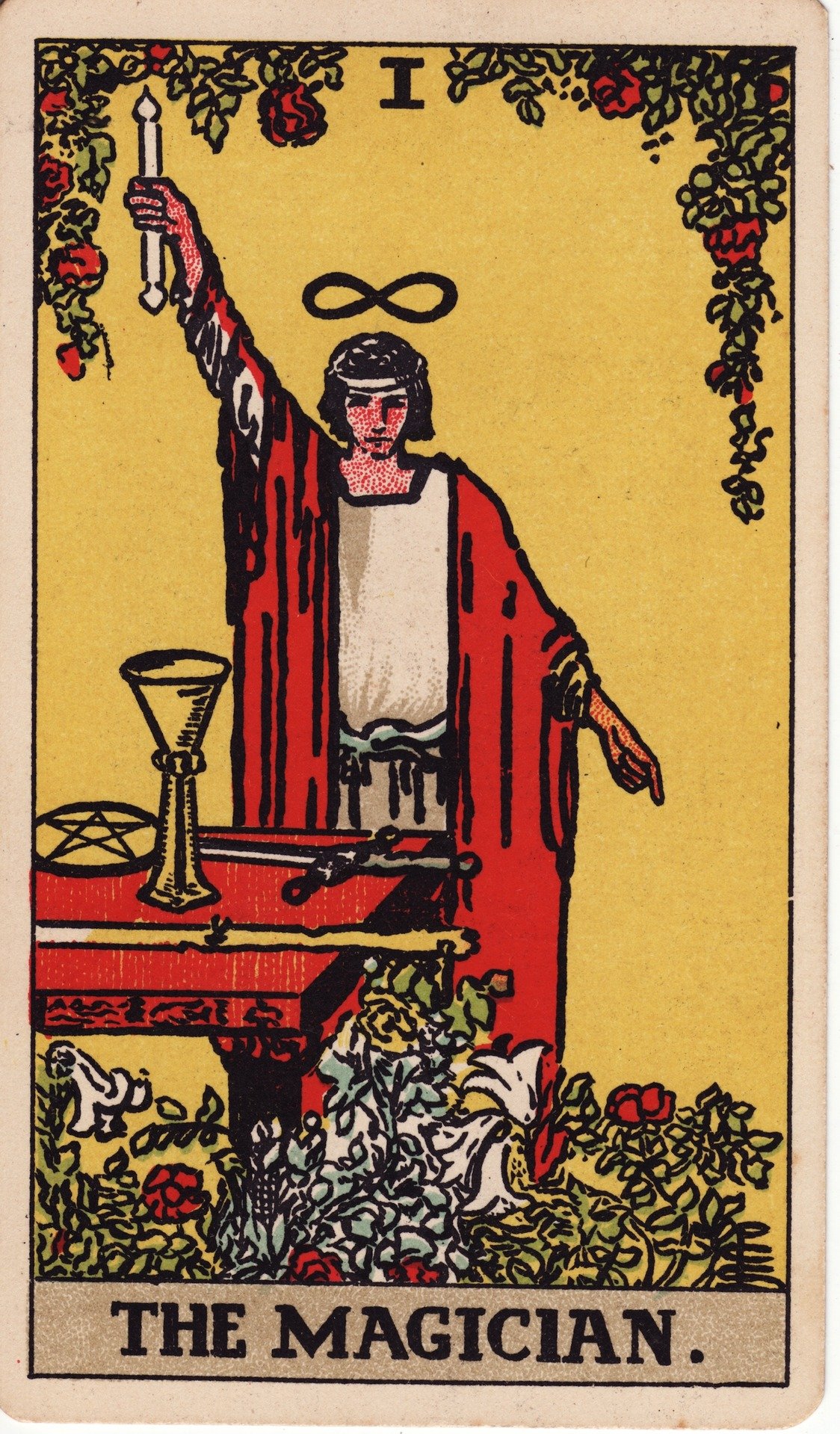
The Magician
The Magician is directed will. This card is the moment a person realises they are not just having an experience, they are participating in the construction of it. The Magician knows that attention is an instrument. Speech is an instrument. Skill is an instrument. The body, the mind, the tools on the table, the contacts in the phone, the hours in the day, the half formed idea, the small amount of confidence already available: all of it can be used. In this system, the Major Arcana begins here because growth starts when the person stops waiting for permission and begins to act with what is already in their hands.
Jungian profile: The Magician is the ego learning to work with libido, meaning psychic life force rather than sexual energy alone. He is the mediator between unconscious material and conscious action. He takes raw potential and gives it a method. In a psyche, this archetype appears when a person is developing agency, speech, craft, technique, and symbolic thinking. He is the inner practitioner, the ritualist, the clever child, the inventor, the therapist who asks the exact question, the performer who knows how to hold the room, and the part of the self that can translate invisible intention into visible behaviour. His shadow is inflation. When he forgets humility, he becomes the trickster who manipulates symbols to control people rather than reveal truth.
Positive attributes
- Creative agency
- Clear speech
- Resourcefulness
- Skill under pressure
- Inventive problem solving
- Focused attention
- Practical magic
- Confidence built through practice
- The ability to make something from what is already available
- A direct relationship between thought, word and action
Negative attributes
- Manipulation
- Spiritual performance
- Cleverness without conscience
- Overpromising
- Using language to avoid accountability
- Mistaking charisma for mastery
- Scattered intention
- Trying to manifest without embodiment
- Treating people as props
- Inflated self belief without the discipline to back it up
Psychologically, The Magician asks where the person has outsourced their power. This is the card of self efficacy. It speaks to the belief that actions can affect outcomes. When this card is strong, the person can tolerate the awkwardness of beginning. They can use repetition without making it mean they are failing. They can learn the instrument, write the pitch, make the call, build the altar, change the room, change the sentence, change the behaviour. When this card is distorted, the person may live in a fantasy of power but avoid the boring proof of power: practice. They may talk beautifully about what they are building while privately knowing they have not built it. They may also become too attached to being impressive, which makes real learning feel humiliating.
When The Magician appears in an Energy Map, the person is built to make invisible intention visible. This is a generator code. It says, “I turn thought into method. I turn method into action. I turn action into evidence.” This person carries the energy of the maker, translator, practitioner, teacher, communicator, technician and symbolic operator. They are often here to learn that their life changes through use, not waiting. Their tools matter, but their relationship to their tools matters more.
The Magician in a map usually points to someone who can influence outcomes through language, ritual, practical skill, timing, repetition and presence. Their field responds when they name what they are doing and then actually do it. The blockage comes when they confuse potential with proof. They may collect systems, courses, cards, words, aesthetics and theories, while quietly avoiding the ordinary discipline that would turn all of that into a life.
If this appears as an attribute
- Character or comfort zone: you default to solving, making, fixing and translating. Use this without becoming the person who performs competence to feel safe.
- Portrait or public self: people experience you as capable, articulate and resourceful. Show your method clearly. Do not hide behind mystique.
- Higher essence: your soul direction strengthens when you become a clean channel for ideas and give them form through craft.
- Heart or relationship point: you love through attention, words and practical effort. Say what you mean, then let behaviour confirm it.
- Material, work or prosperity point: money comes through skill, communication, teaching, content, tools, service design and applied knowledge.
- Ancestral or child-parent point: you may carry a family pattern around cleverness, survival through performance, or needing to prove usefulness early.
- Health map or chakra point: the body may ask for nervous system coherence between thought, speech, hands and action. Scattered focus leaks energy.
What to do with it
- Turn every big idea into one visible action within 24 hours.
- Audit your tools. Keep the ones you use. Stop worshipping the ones you collect.
- Practise clean speech. No vague promises, no spiritual theatre, no over-explaining.
- Create a repeatable method for your work so your power has a container.
- Use your hands. Write, build, record, cook, repair, draw, organise. Bring the field into matter.
- When you feel blocked, ask: “What is already on the table?” Then use that first.
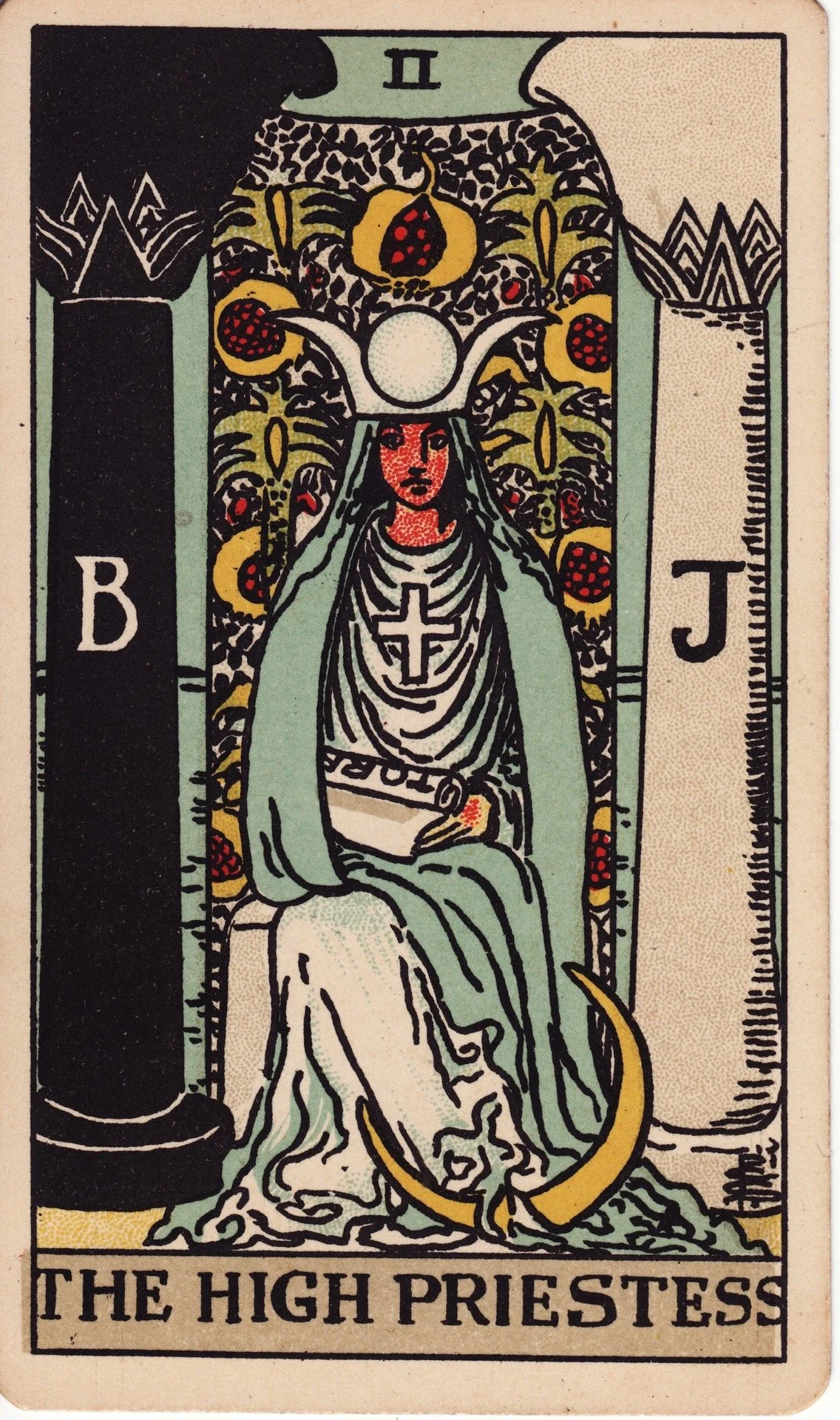
The High Priestess
The High Priestess is interior perception. She is the part of the psyche that knows before the conscious mind can explain how it knows. She does not rush to disclose. She waits, listens, records, dreams, notices the body, notices the pattern, notices the silence after the answer. This card is not passive. It is disciplined receptivity. It is the ability to sit at the threshold between the known and unknown without forcing premature certainty.
Jungian profile: The High Priestess is the anima as guide, the inner feminine as symbolic intelligence, and the guardian of unconscious material. She is close to the collective unconscious because she understands image, dream, myth, and bodily intuition. She does not deal in linear proof first. She deals in resonance, repetition, atmosphere, and the strange accuracy of what returns. In a person, this archetype develops when the ego learns that not everything true arrives through logic. Her shadow is secrecy used as superiority. She can become the person who hides behind mystery, withholds truth to maintain power, or confuses dissociation with depth.
Positive attributes
- Intuition
- Emotional privacy
- Symbolic intelligence
- Dream literacy
- Patience
- Deep listening
- Energetic sensitivity
- Respect for timing
- Inner authority
- The ability to hold a question without rushing the answer
Negative attributes
- Withdrawal
- Withholding
- Mystifying simple issues
- Fear of being seen
- Using silence as punishment
- Spiritual superiority
- Confusing anxiety with intuition
- Avoiding direct conversation
- Living in implication
- Knowing the truth but refusing to act on it
Psychologically, The High Priestess is the card of the unconscious trying to speak. She often appears around material that has not yet become language. The person may feel something but not know how to name it. They may sense a pattern before they can prove it. They may need less external noise, not more advice. This archetype also asks for discernment. Intuition is cleanest when the nervous system is not hijacked. Fear shouts. Intuition is usually quieter, steadier, and less theatrical. The High Priestess teaches the difference between a signal and a projection.
When The High Priestess appears in an Energy Map, the person is coded for perception beneath the surface. This is the inner knowing code. It says the map holder has access to information before the conscious mind can explain it. They sense tone, atmosphere, timing, emotional subtext, hidden motives and the thing a room is avoiding. They often know before they know why they know.
This placement can make someone deeply intuitive, observant and internally guided. It can also make them secretive, withdrawn, hard to reach, or too attached to silence as a form of control. The High Priestess teaches discernment between intuition and projection. A true signal arrives cleanly. A projection arrives charged, repetitive, defensive and hungry for confirmation.
If this appears as an attribute
- Character or comfort zone: you retreat inward to understand life. This is useful, but isolation becomes a trap when it replaces participation.
- Portrait or public self: people may see you as mysterious, private, psychic, hard to read, or quietly powerful. Let people earn access without making distance your identity.
- Higher essence: your spiritual direction grows through silence, symbolic study, dream work, contemplation and trust in subtle perception.
- Heart or relationship point: you need emotional privacy and energetic safety. Speak the truth once you have heard it inside yourself.
- Material, work or prosperity point: money may come through insight, research, hidden knowledge, therapeutic space, divination, strategy, archives, pattern recognition or confidential work.
- Ancestral or child-parent point: you may carry family secrets, unspoken grief, women who knew but could not say, or children who learned to read the room for safety.
- Health map or chakra point: the body may respond strongly to overstimulation, poor sleep, hormonal rhythms, sensory load, or ignoring inner signals.
What to do with it
- Separate intuition from anxiety by tracking what arrives quietly and what arrives with panic.
- Keep a private record of dreams, symbols, repeated phrases and body sensations.
- Stop forcing yourself to explain everything immediately. Let some knowing mature.
- Practise saying, “I need time to feel into that,” without apologising.
- Bring one hidden thing into language each week. The High Priestess needs expression too.
- Protect your energetic input. Less noise gives your signal more authority.
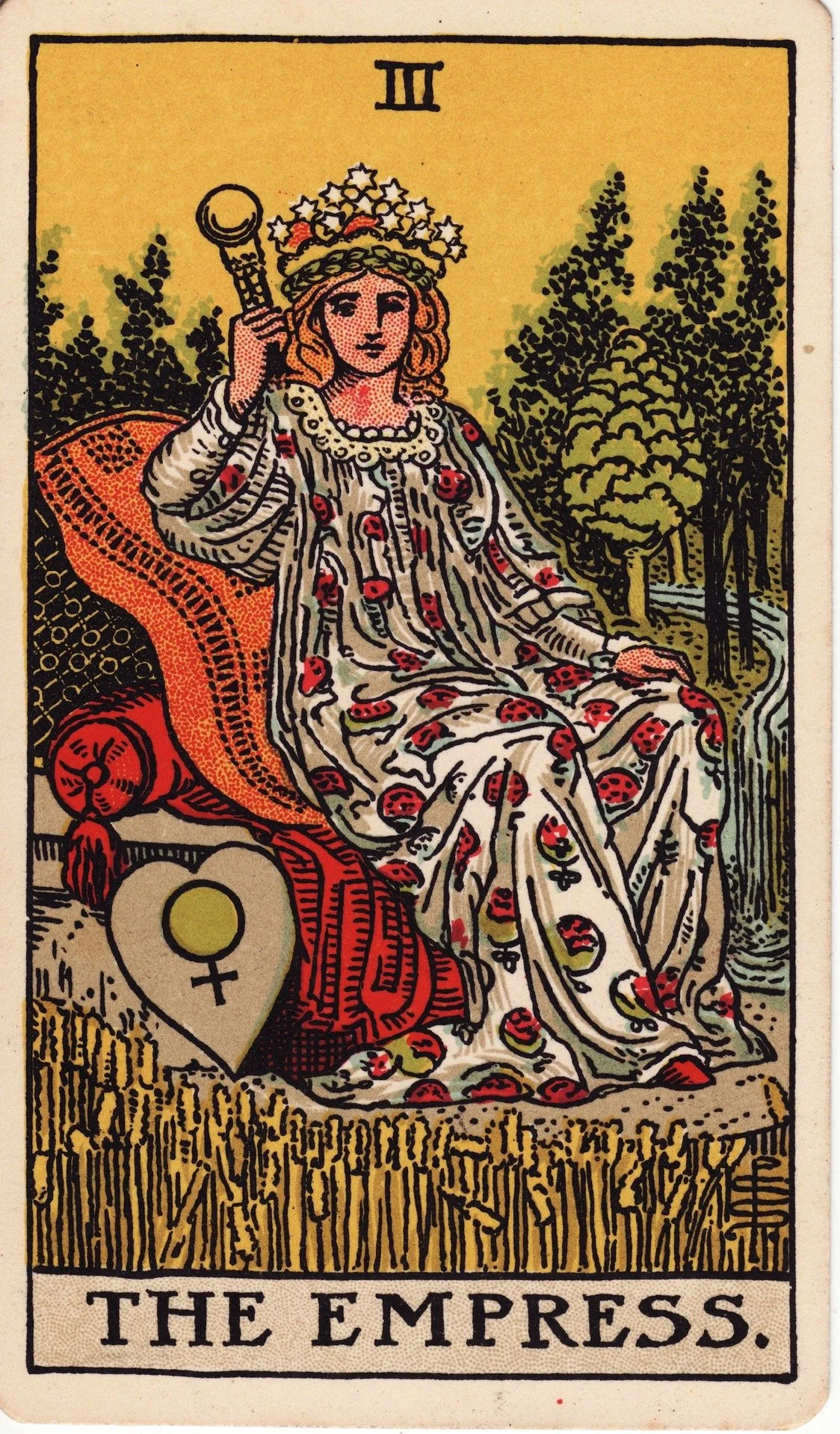
The Empress
The Empress is embodiment, fertility, nourishment, pleasure, beauty, and the intelligence of organic growth. She is the card of being well resourced enough to let something grow in its own time. She understands seasons. She understands food, rest, touch, beauty, mess, appetite, and repair. She is not productivity dressed in flowers. She is the living field that makes creation possible.
Jungian profile: The Empress is the Great Mother archetype in her generous form. She is matter as sacred, body as wisdom, nature as instruction, and love as a force that feeds development. In a psyche, she is the capacity to receive and metabolise care. She is also the inner parent who knows that life cannot thrive on criticism alone. Her shadow is the devouring mother: over involvement, emotional flooding, possessiveness, indulgence without structure, and the belief that love means never allowing frustration.
Positive attributes
- Nourishment
- Sensuality
- Creativity
- Embodiment
- Warmth
- Generosity
- Beauty
- Organic growth
- Maternal protection
- The ability to make life feel safe enough to bloom
Negative attributes
- Smothering
- Overgiving
- Possessiveness
- Indulgence
- Emotional dependency
- Avoidance of boundaries
- Mistaking comfort for growth
- Using care to control
- Body disconnection masked by aesthetics
- Creating more than you can sustain
Psychologically, The Empress speaks to attachment, receiving, and the body. A person can be brilliant, spiritual, ambitious and still unable to receive simple nourishment. This card asks whether the person can let life touch them. Can they eat without guilt, rest without earning it, create without immediately monetising it, be loved without performing? The Empress also exposes the wound around mothering: too much, too little, unsafe, inconsistent, invasive, absent. The work is to develop a relationship with care that does not collapse into neediness or harden into self denial.
When The Empress appears in an Energy Map, the person is built around receptivity, creation, nourishment, beauty and embodiment. This is the life-giver code. It says the map holder has a natural ability to grow things, people, spaces, projects and emotional climates. They understand atmosphere. They can make something feel alive.
The Empress is not soft in a weak way. She is fertile, sensual, resourced and connected to the body. She teaches the difference between genuine care and over-mothering. In a map, this card can show a person who creates abundance through warmth, aesthetics, relational intelligence, food, touch, design, nature, art, parenting, business incubation or emotional holding. The shadow is smothering, self-abandonment, indulgence, passive expectation, or confusing being needed with being loved.
If this appears as an attribute
- Character or comfort zone: you naturally nurture and create. Watch the habit of becoming the source for everyone while neglecting your own body.
- Portrait or public self: people may experience you as warm, attractive, creative, comforting or abundant. Let beauty be functional, not performative.
- Higher essence: your direction opens through embodiment, nature, pleasure, art, receiving and trusting organic timing.
- Heart or relationship point: love moves through care, loyalty, sensuality and protection. Ask for reciprocity before resentment begins.
- Material, work or prosperity point: money can flow through beauty, wellness, food, interiors, creativity, women, families, care work, branding, fertility, hospitality or embodied products.
- Ancestral or child-parent point: you may carry mother-line themes around sacrifice, fertility, body shame, resource hoarding, emotional labour or women being valued only for what they give.
- Health map or chakra point: the body may speak through hormones, digestion, skin, reproductive themes, appetite, touch deprivation or lack of pleasure.
What to do with it
- Build rituals of receiving, not only giving.
- Make the body a decision-maker. Notice what opens, softens, contracts or refuses.
- Charge properly for anything that requires your care, taste or emotional labour.
- Create environments that feed you before they impress anyone else.
- Practise clean mothering: support growth without taking over responsibility.
- Let pleasure become information. Your body often knows before your mind admits it.
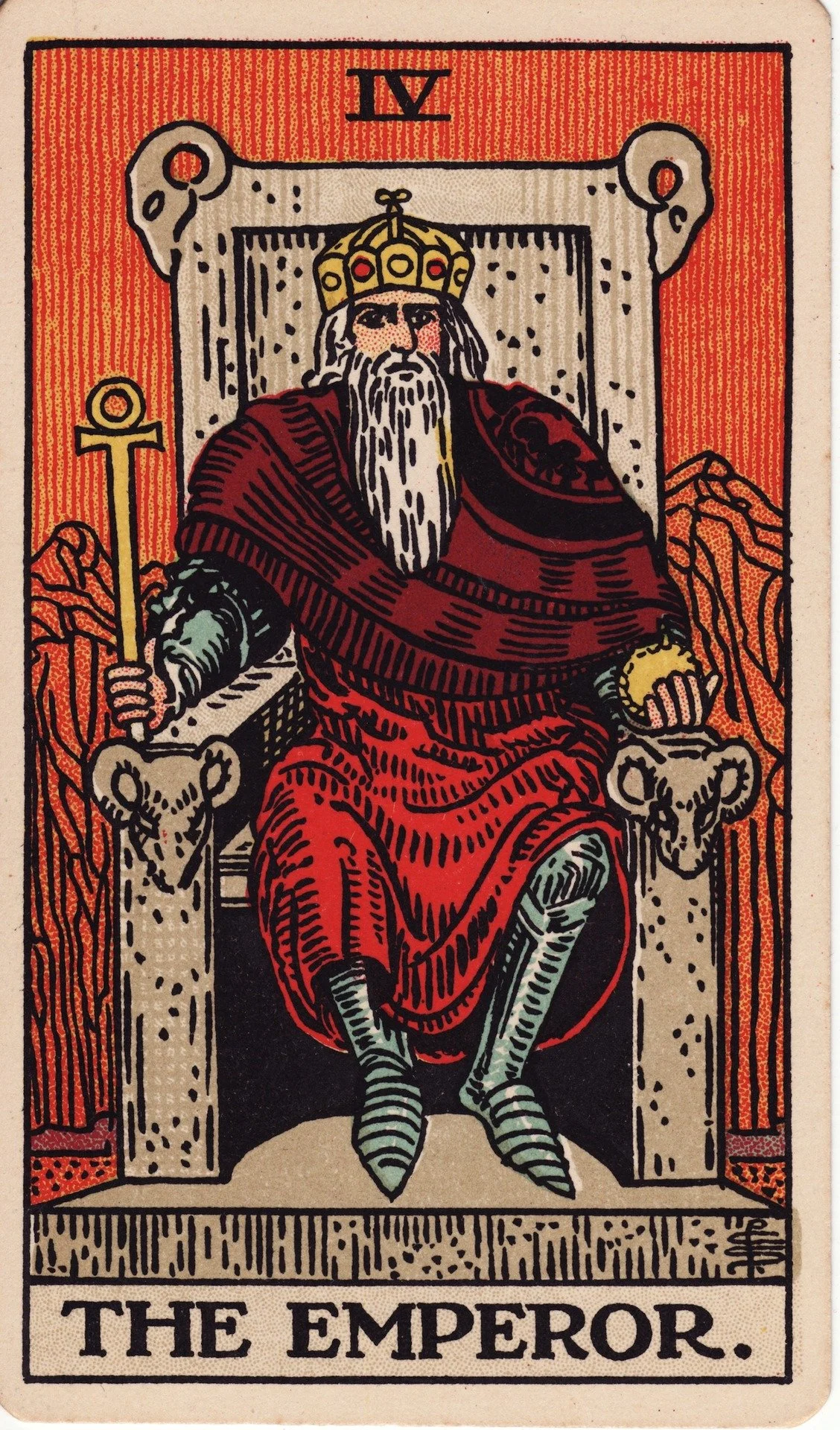
The Emperor
The Emperor is structure, order, protection, discipline, responsibility, and clean authority. He gives form to what The Empress grows. He builds the container, names the rule, keeps the promise, holds the line, and makes the decision that protects the whole system. This card is the difference between wanting a life and governing one.
Jungian profile: The Emperor is the Father archetype, the King, the Lawgiver, the organiser of psychic territory. In the psyche, he is the part that can say yes and mean it, say no and mean it, and tolerate being disliked when the boundary is correct. His healthy expression creates inner sovereignty. His distorted expression becomes tyranny, rigidity, domination, emotional constipation, and fear disguised as control. The Emperor shadow often appears when a person has never experienced safe authority, so they either reject all structure or become harsh to avoid vulnerability.
Positive attributes
- Discipline
- Boundaries
- Protection
- Leadership
- Consistency
- Decision making
- Self respect
- Strategic thinking
- Reliability
- The ability to turn values into rules and rules into behaviour
Negative attributes
- Control
- Domination
- Rigidity
- Emotional shutdown
- Authoritarian behaviour
- Fear of softness
- Needing to be right
- Power used to avoid intimacy
- Punishing vulnerability
- Confusing order with safety
Psychologically, The Emperor asks what governs the person. Is it values, fear, habit, family scripts, shame, urgency, or someone else's approval? This card is clean when the person can create a stable internal authority. They do what they said they would do. They do not need every boundary to be understood before they keep it. They understand that love without structure becomes chaos, and structure without love becomes a prison. The Emperor often appears when the nervous system needs predictability. It may be asking for a routine, a decision, a policy, a standard, a budget, a bed time, or a difficult conversation.
When The Emperor appears in an Energy Map, the person is coded for structure, leadership, boundaries, protection and real-world authority. This is the stabiliser code. It shows where the map holder must become the adult in the room, internally first, then externally. The Emperor builds containers strong enough to hold desire, emotion, creativity and responsibility.
This placement often appears for people who need to develop self-command, routine, backbone, strategic decision-making and a clean relationship with power. The gift is protection through order. The shadow is rigidity, control, emotional distance, dominance, fear of vulnerability, or using rules to avoid feeling. The Emperor is healthy when authority serves life. He becomes distorted when authority serves ego.
If this appears as an attribute
- Character or comfort zone: you seek control, clarity and structure. Use this to lead yourself, not to make everyone else easier to manage.
- Portrait or public self: people may see you as capable, firm, composed, intimidating, dependable or hard to move. Let warmth sit beside authority.
- Higher essence: your direction opens through leadership, discipline, stewardship and building systems that outlast mood.
- Heart or relationship point: you love through loyalty, provision and protection. Learn to say what you feel, not only what you will do.
- Material, work or prosperity point: money comes through management, strategy, leadership, property, governance, operations, boundaries, business structure and decisive offers.
- Ancestral or child-parent point: you may carry father-line themes, absent authority, authoritarian control, emotional restriction, duty, or early pressure to be mature.
- Health map or chakra point: the body may ask for regulation through routine, posture, strength, sleep, blood pressure awareness, skeletal support and grounded habits.
What to do with it
- Create rules that protect your life force, not rules that punish your humanity.
- Make decisions faster. The Emperor weakens when everything stays negotiable.
- Build a weekly operating system for money, work, energy and recovery.
- Practise emotional authority: name what is true without collapsing or attacking.
- Strengthen boundaries before resentment turns into coldness.
- Lead by creating safety, clarity and consequence.
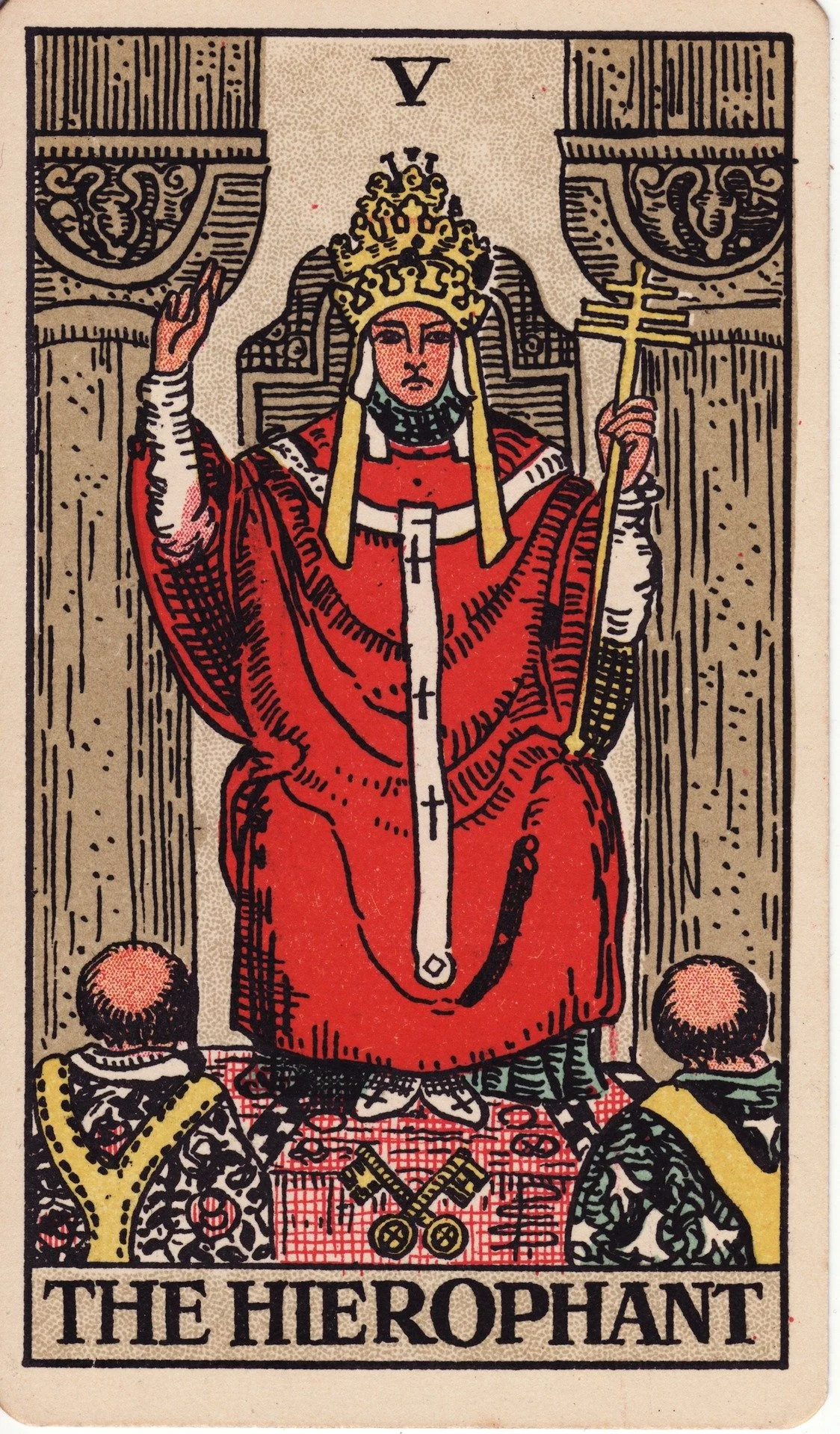
The Hierophant
The Hierophant is tradition, teaching, belief, institution, lineage, and the transmission of knowledge. He is the part of life where private experience meets a shared language. He asks what has been handed down, what has been made sacred, what has been repeated for generations, and what kind of belonging is being purchased through obedience.
Jungian profile: The Hierophant is the Wise Old Man, the priest, the teacher, the elder, the keeper of doctrine, and sometimes the gatekeeper. In a psyche, he is the inner authority formed by family, school, religion, culture, therapy language, spiritual communities, professional codes, and social rules. His positive form gives orientation and ethical containment. His shadow is dogma. He becomes the voice that says, 'This is how people like us do things,' even when the soul has outgrown the room.
Positive attributes
- Wisdom
- Mentorship
- Moral clarity
- Tradition
- Belonging
- Study
- Initiation
- Respect for lineage
- Ethical practice
- The ability to learn from something bigger than the personal ego
Negative attributes
- Dogma
- Shame
- Groupthink
- Moral superiority
- Spiritual bypassing
- Obedience without discernment
- Fear of exile
- Outsourcing conscience
- Using tradition to avoid truth
- Confusing belonging with freedom
Psychologically, The Hierophant asks who installed the rule. A person may call something intuition when it is actually conditioning. They may call something morality when it is actually fear of rejection. They may also throw away every tradition because one authority figure misused power. This card requires nuance. Some structures carry wisdom. Some carry control. The psyche matures when it can receive teaching without surrendering discernment. The Hierophant is especially important in spiritual work because it exposes the need to question what has been normalised as sacred.
When The Hierophant appears in an Energy Map, the person is coded for teaching, tradition, transmission, belief systems and initiation. This is the meaning-maker code. It shows where a person is shaped by inherited frameworks and where they are also capable of becoming a guide, interpreter, mentor or custodian of knowledge.
The Hierophant often points to the tension between belonging and obedience. In its clean expression, this card gives reverence, study, ethics, lineage, ritual, moral intelligence and the ability to translate wisdom into practice. In its distorted expression, it becomes dogma, gatekeeping, spiritual superiority, fear of deviation, or outsourcing truth to an institution, teacher, family system or ideology.
If this appears as an attribute
- Character or comfort zone: you look for rules, teachings and recognised paths. Use structure as a support, then test whether it still feels true.
- Portrait or public self: people may see you as wise, principled, trained, devotional, traditional or teacher-like. Let your lived experience speak as strongly as your knowledge.
- Higher essence: your direction opens through study, mentorship, ritual, ethics, community and translating spiritual knowledge into daily conduct.
- Heart or relationship point: love is shaped by values. You need shared principles, but you must avoid turning your partner into a student.
- Material, work or prosperity point: money can come through teaching, courses, mentoring, institutions, spiritual education, consulting, ceremonies, membership spaces or frameworks.
- Ancestral or child-parent point: you may carry inherited religion, class rules, family codes, shame teachings, obedience patterns, or pressure to be respectable.
- Health map or chakra point: the body may respond to conflict between personal truth and inherited rules, especially through the throat, neck, jaw, immune response or stress patterns.
What to do with it
- Name the beliefs you inherited before calling them intuition.
- Keep what creates integrity. Release what creates fear.
- Teach from lived integration, not memorised doctrine.
- Create rituals that regulate your system and connect you to meaning.
- Question any authority that requires self-abandonment as proof of loyalty.
- Build a body of work with clear ethics and human language.
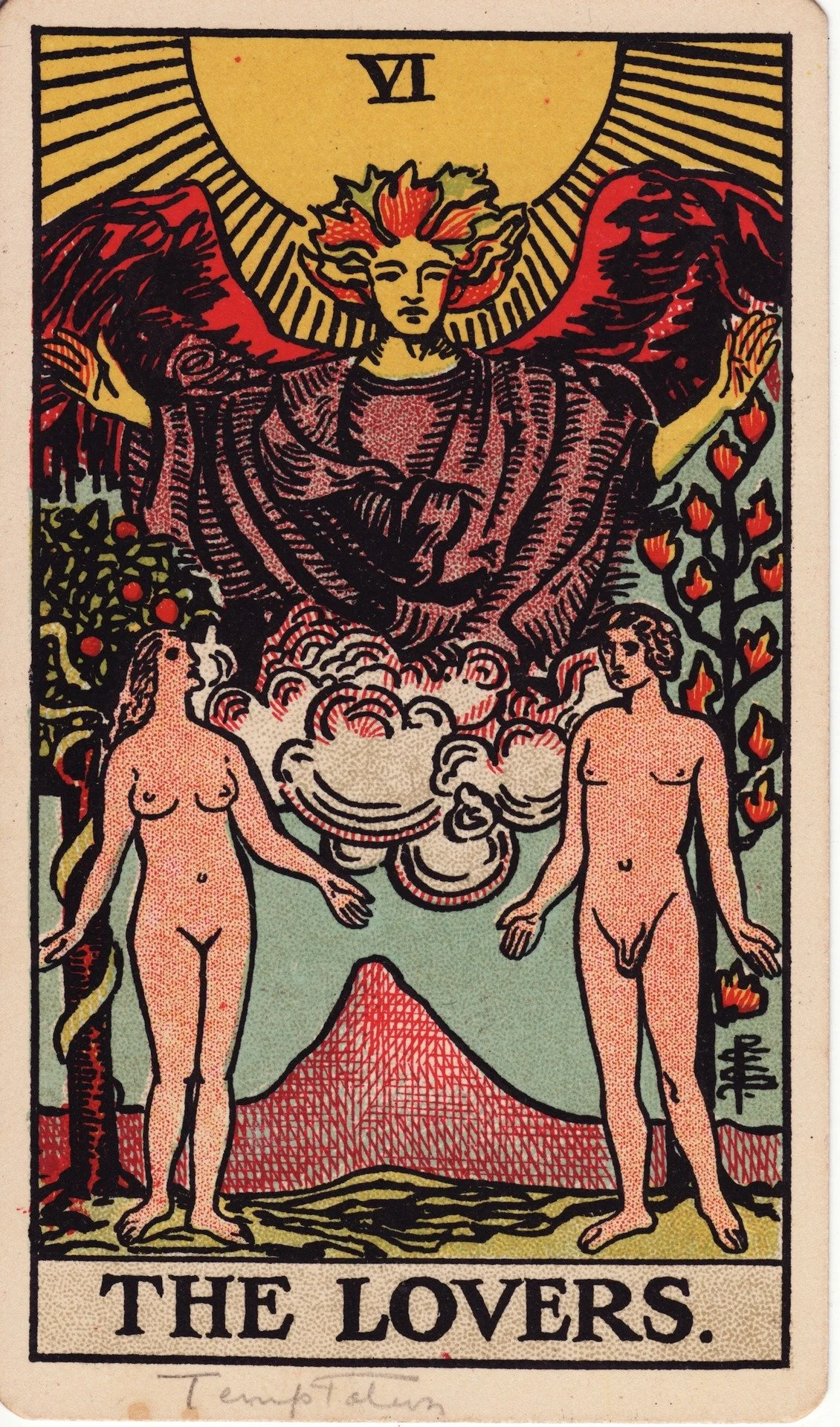
The Lovers
The Lovers is union, attraction, values, intimacy, and choice. It is often romantic, but its deeper movement is alignment. This card asks what the person chooses when desire, conscience, body, fantasy, loyalty, and fear all speak at once. Love is not only a feeling here. Love is a sorting mechanism. It reveals what the person values enough to choose.
Jungian profile: The Lovers is the conjunction of opposites. It is anima and animus meeting, conscious and unconscious entering dialogue, instinct and ethics negotiating a shared life. In a psyche, this card appears when the person must integrate split parts of themselves rather than keep projecting one side onto another person. The beloved becomes a mirror. The attraction may be real, but it also carries psychic material. The shadow is fusion, projection, temptation, triangulation, and the fantasy that another person will complete an avoided self.
Positive attributes
- Love
- Alignment
- Honest choice
- Mutuality
- Integration
- Vulnerability
- Relational intelligence
- Value led decisions
- Sexual honesty
- The courage to choose what matches the truth of the self
Negative attributes
- Projection
- Codependency
- Indecision
- People pleasing
- Infidelity to self
- Romantic fantasy
- Avoiding responsibility through attraction
- Confusing chemistry with compatibility
- Seeking completion through another
- Choosing approval over truth
Psychologically, The Lovers asks where the person is divided. They may say they want one thing while choosing another. They may want intimacy but choose unavailable people. They may want freedom but keep asking a partner to parent them. They may want truth but keep bargaining with the version of themselves that wants to be liked. This card is about the pain of choice because every real choice ends an alternative. Mature love requires grief. The person has to grieve the fantasy of being everything, having everything, and pleasing everyone.
When The Lovers appears in an Energy Map, the person is coded for choice, intimacy, values, attraction and inner alignment. This is the relational choice code. It shows where the map holder learns that every meaningful decision creates a relationship: with another person, with a path, with a value, with a version of the self.
The Lovers is often misunderstood as simple romance. In Energy Mapping, it is about congruence. The person must learn to choose from their whole self, not from hunger, fantasy, approval-seeking or fear of being alone. The gift is honest connection. The shadow is triangulation, indecision, people-pleasing, temptation, erotic projection, or choosing the person who activates the wound rather than the person who meets the truth.
If this appears as an attribute
- Character or comfort zone: you process life through relationship, beauty, desire and choice. Do not let other people become the mirror you cannot put down.
- Portrait or public self: people may see you as magnetic, relational, attractive, emotionally available or choice-led. Make your values visible.
- Higher essence: your direction opens when your choices match your real values, not your conditioned idea of being wanted.
- Heart or relationship point: intimacy is a core curriculum. You need honesty, mutual choice and the courage to stop performing compatibility.
- Material, work or prosperity point: money may come through partnerships, branding, aesthetics, client relationships, matchmaking, collaboration, beauty, negotiation or value-led offers.
- Ancestral or child-parent point: you may carry relationship templates around loyalty, betrayal, duty, forbidden desire, family approval or choosing love at the cost of self.
- Health map or chakra point: the body may speak through the heart, lungs, skin, hormones or nervous system when you live in emotional incongruence.
What to do with it
- Write down your non-negotiable values and compare your current choices against them.
- Stop asking, “Do they choose me?” Ask, “Do I choose this from my whole self?”
- Notice attraction without obeying it automatically.
- Practise direct communication before ambiguity becomes theatre.
- Make decisions through alignment, not emotional intensity.
- Choose the path that gives you self-respect after the excitement settles.
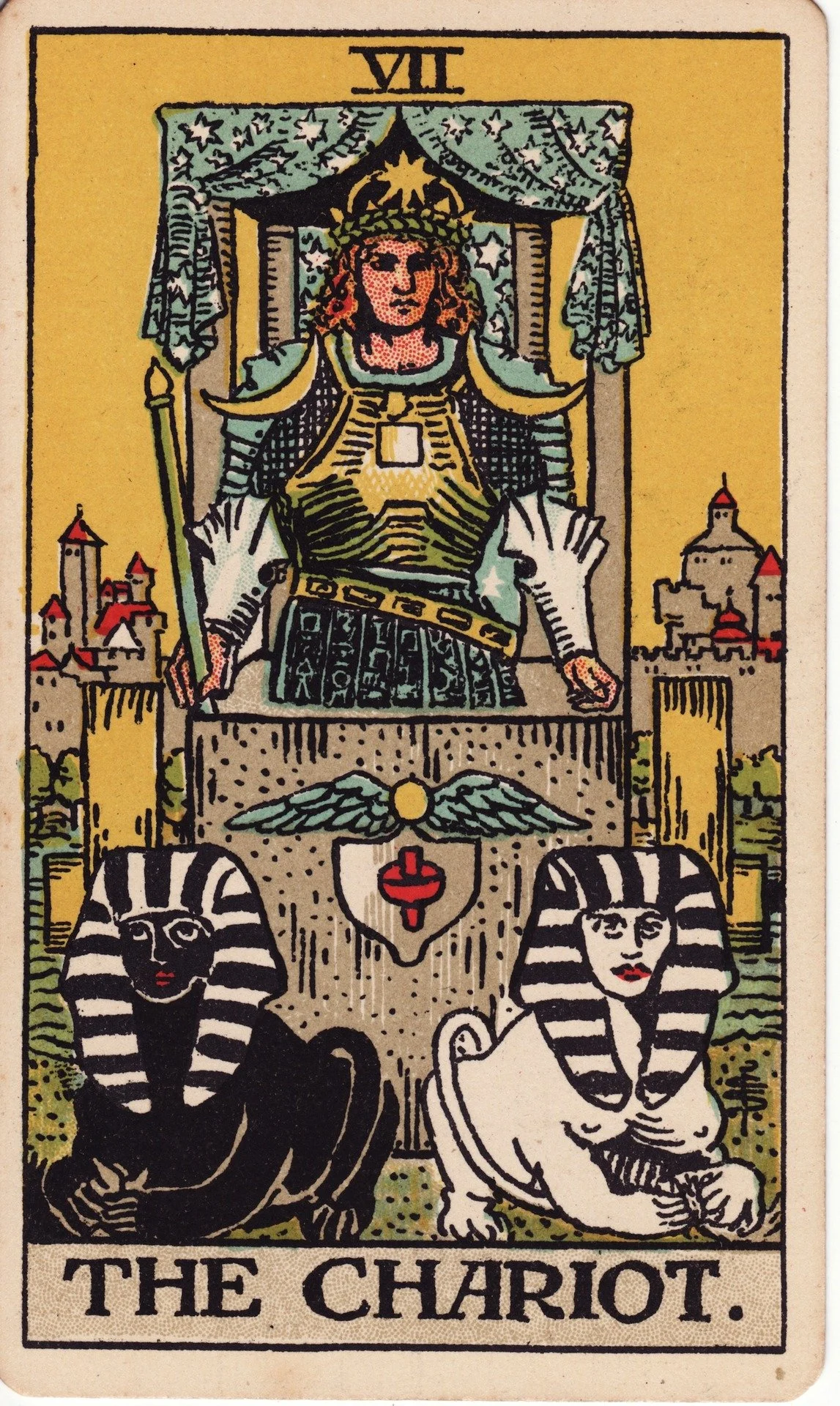
The Chariot
The Chariot is movement, will, control, momentum, and self command. It is the psyche learning to drive itself instead of being dragged by competing impulses. This card is not random speed. It is directed force. The person has to hold two different energies in the same vehicle and move without splitting apart.
Jungian profile: The Chariot is the heroic ego on the road of individuation. It has left the safety of inherited belonging and must now test its will in the world. The charioteer is not mature because there is no conflict. The charioteer is mature because conflict is being harnessed. In the psyche, this archetype is executive function, ambition, emotional containment, and the ability to move through resistance. Its shadow is conquest, overcontrol, emotional armouring, and the belief that forward motion is the same as integration.
Positive attributes
- Determination
- Self control
- Momentum
- Courage
- Direction
- Focus
- Emotional containment
- Competitive strength
- Resilience
- The ability to move while holding internal tension
Negative attributes
- Force
- Aggression
- Overcontrol
- Burnout
- Avoiding feeling through action
- Needing to win
- Impatience
- Rigid goals
- Treating the body like a machine
- Moving fast to avoid asking where you are going
Psychologically, The Chariot asks what is driving. Many people think they are being ambitious when they are actually being chased by fear. They think they are focused when they are dissociated from the cost. This card is healthy when there is a driver, a direction, and an ethical reason to move. It becomes distorted when the person cannot stop without feeling worthless. The Chariot also speaks to the nervous system capacity to hold activation without spilling it into panic, control, or conflict. It is the art of staying in the seat.
When The Chariot appears in an Energy Map, the person is coded for movement, direction, self-mastery and momentum. This is the driver code. It shows someone who must learn to take charge of competing impulses and move forward without waiting for every part of the psyche to feel comfortable.
The Chariot is will under tension. One part wants safety, one part wants expansion. One part wants to fight, one part wants to flee. One part wants approval, one part wants freedom. The work is to hold the reins without splitting the self. The gift is determination, courage, speed and victory through focus. The shadow is force, emotional suppression, burnout, aggression, escape, or driving the body harder than the soul can tolerate.
If this appears as an attribute
- Character or comfort zone: you push through. This gives stamina, but it can also make rest feel like failure.
- Portrait or public self: people may see you as driven, ambitious, strong, competitive or hard to stop. Let them also see your humanity.
- Higher essence: your direction opens through decisive movement, travel, challenges, goal-setting and learning to command your energy.
- Heart or relationship point: you may love by pursuing, protecting or fixing. Slow down enough to receive and respond.
- Material, work or prosperity point: money can come through launches, transport, performance, leadership, crisis handling, sports, campaigns, travel, sales or high-momentum projects.
- Ancestral or child-parent point: you may carry survival patterns around having to keep going, leaving quickly, winning approval, or becoming tough too early.
- Health map or chakra point: the body may speak through muscles, shoulders, stomach, adrenaline, sleep disruption or symptoms linked to constant activation.
What to do with it
- Pick one direction and stop giving equal energy to every possible path.
- Build recovery into the plan before your body forces it.
- Regulate before you accelerate.
- Use deadlines, movement and visible targets to focus the field.
- Notice where you mistake pressure for purpose.
- Practise asking the softer part of you what it needs before you drive over it.
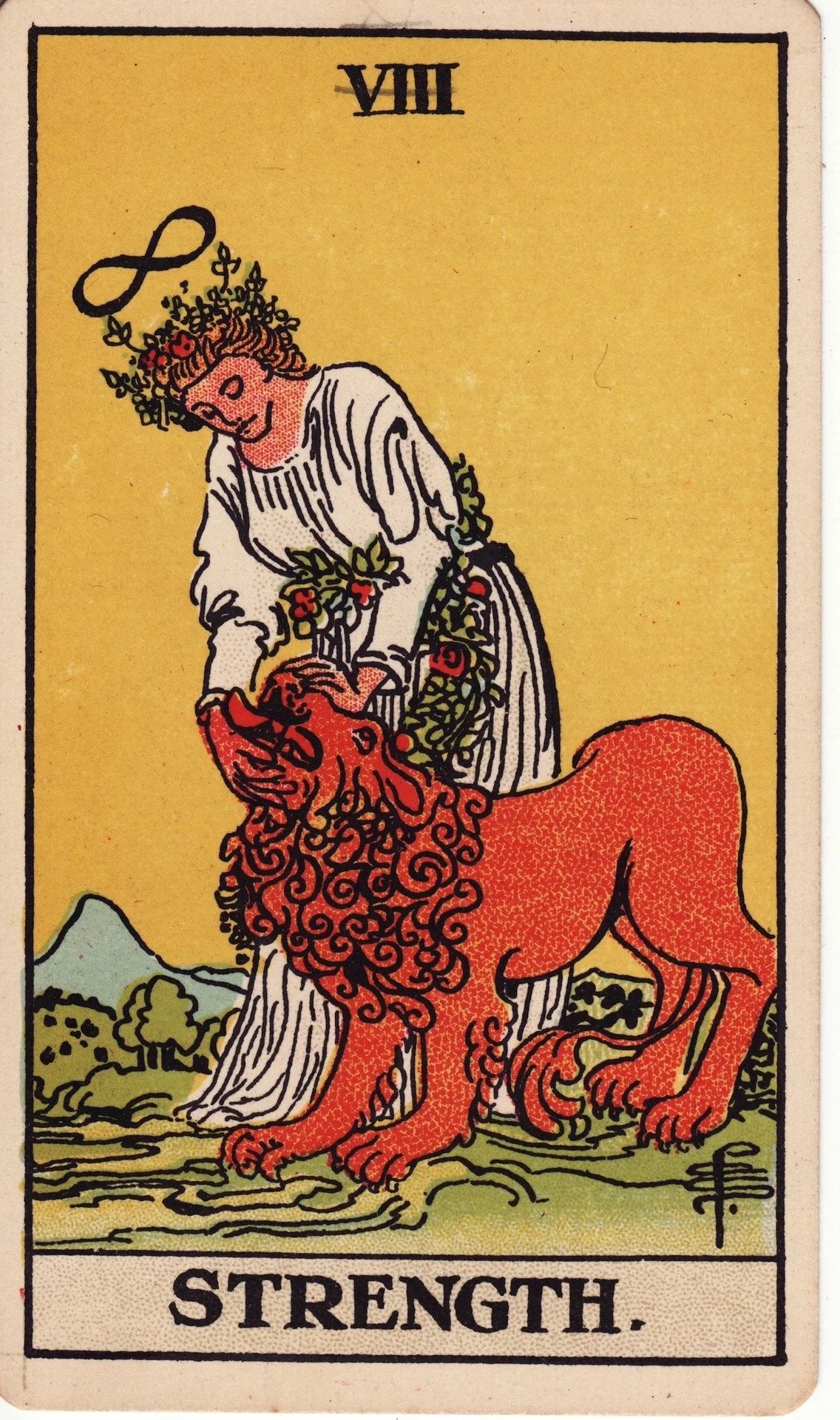
Strength
Strength is inner steadiness, courage, patience, and compassionate influence over instinct. It is not brute force. It is the ability to stay present with the animal self without shaming it, indulging it, or pretending it does not exist. Strength knows the lion is not an enemy. The lion is life force that needs relationship.
Jungian profile: Strength is the meeting between ego and instinct. The human figure does not kill the animal. She relates to it. In Jungian terms, this card is shadow integration through tenderness and firmness. It is the psyche learning that instinct becomes dangerous when it is repressed, demonised, or allowed to rule without consciousness. The shadow of Strength is performance softness, suppressed rage, moralised calm, and the fantasy of being above appetite, anger, fear, jealousy, need, or desire.
Positive attributes
- Courage
- Patience
- Self trust
- Emotional regulation
- Compassion
- Embodied confidence
- Gentle authority
- Integration of instinct
- Steady presence
- The ability to influence without domination
Negative attributes
- Suppressed anger
- False gentleness
- Fear of intensity
- People pleasing
- Using calmness as control
- Shame around desire
- Passive aggression
- Overtaming the self
- Moral superiority
- Calling fear 'peace' because conflict feels unsafe
Psychologically, Strength asks how the person relates to their own intensity. The answer tells you a lot. Some people fear their anger because they have only seen anger destroy. Some fear their desire because they think desire makes them needy. Some fear their ambition because they have confused power with cruelty. Strength develops when the person can sit beside these forces and make them conscious. The goal is not to become tame. The goal is to become trustworthy with power.
When Strength appears in an Energy Map, the person is coded for emotional courage, nervous system mastery, compassion and embodied restraint. This is the gentle power code. It shows someone who is here to learn that force is not the same as strength. Real strength is the ability to stay present with instinct, anger, fear, desire and vulnerability without becoming ruled by them.
Strength often appears for people with intense inner animals: powerful emotions, strong appetites, protective instincts, sensitivity, passion, rage, grief or sexual charge. The gift is taming through relationship, not domination. The shadow is repression, performative niceness, fear of anger, rescuing others, or becoming so controlled that vitality disappears.
If this appears as an attribute
- Character or comfort zone: you endure, soothe and contain. Make sure you are not using composure to hide the truth.
- Portrait or public self: people may see you as calm, kind, resilient, magnetic or emotionally mature. Let your boundaries be as visible as your warmth.
- Higher essence: your direction opens through compassion, embodiment, brave tenderness and a clean relationship with instinct.
- Heart or relationship point: love requires patience and honesty about desire, anger and need. Do not mother the lion while starving yourself.
- Material, work or prosperity point: money may come through coaching, bodywork, animal work, trauma-informed spaces, performance, leadership, beauty, sexuality, fitness or emotional regulation work.
- Ancestral or child-parent point: you may carry patterns around being the strong one, hiding rage, calming volatile adults, or confusing love with emotional labour.
- Health map or chakra point: the body may speak through the heart, spine, jaw, muscles, inflammation, fatigue, adrenal stress or tension from swallowed emotion.
What to do with it
- Build capacity slowly. Do not flood your system to prove you are powerful.
- Let anger become information before it becomes performance.
- Practise firm kindness: direct words, soft body, clean boundary.
- Work with the body through breath, strength training, sound, shaking, walking or touch.
- Stop rewarding yourself for over-enduring.
- Ask what your inner animal is protecting, then negotiate with it respectfully.
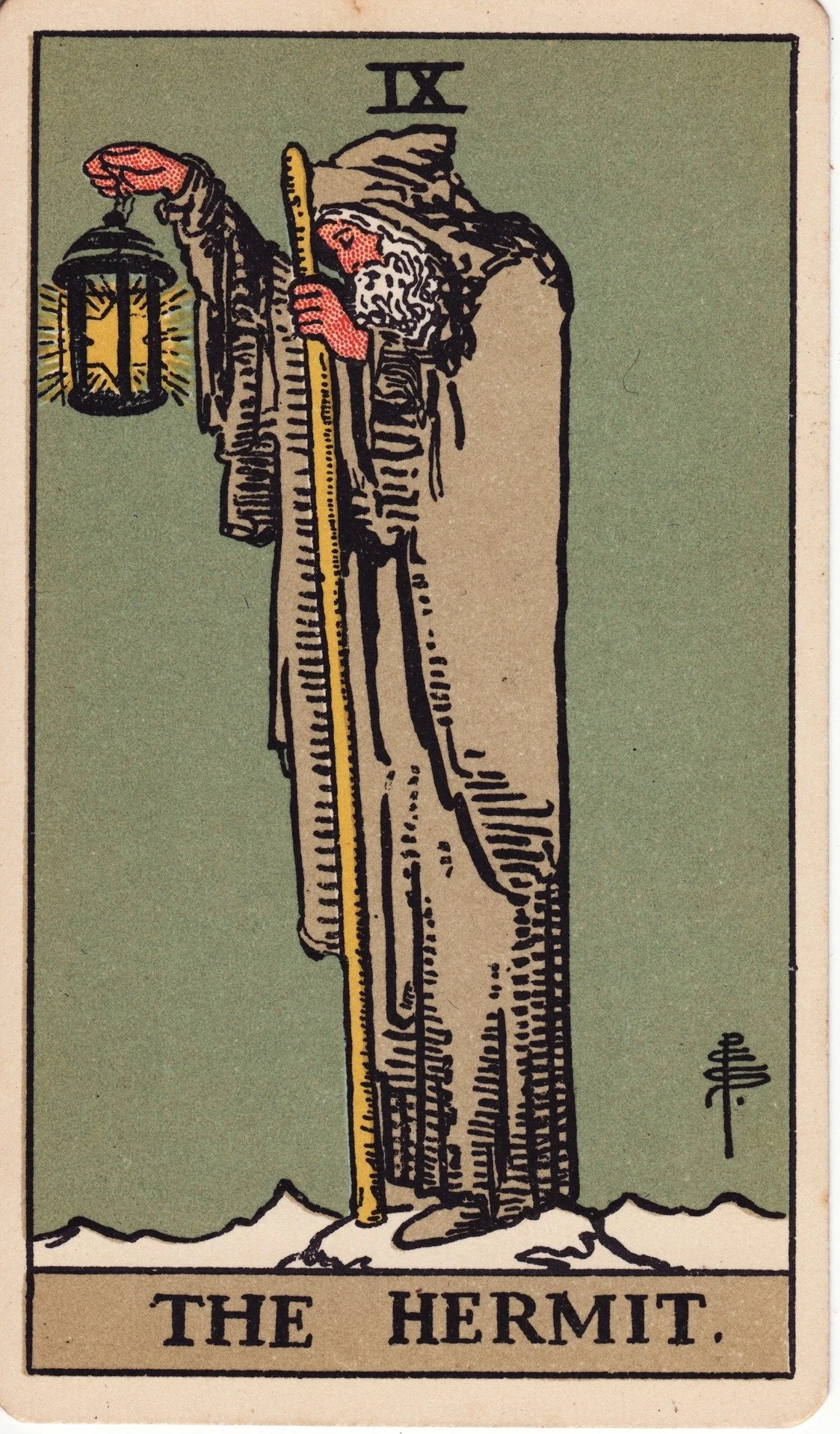
The Hermit
The Hermit is solitude, inner guidance, reflection, humility, and the slow light of earned wisdom. He withdraws to see clearly, not to disappear. This card is the part of the psyche that needs quiet enough to hear its own life. It is a lamp, not a spotlight. It shows the next few steps, not the entire mountain.
Jungian profile: The Hermit is the Wise Old Man in his inward form. He is the analyst, the monk, the elder, the night walker, the researcher of the soul. He carries light because he has spent time in darkness without trying to make it decorative. In a psyche, this archetype appears when the person is separating from collective noise and developing internal counsel. His shadow is isolation, superiority, chronic withdrawal, and the belief that needing people is a weakness.
Positive attributes
- Wisdom
- Solitude
- Discernment
- Reflection
- Humility
- Spiritual maturity
- Self knowledge
- Patience
- Clean withdrawal
- The ability to be alone without abandoning life
Negative attributes
- Isolation
- Avoidance
- Emotional distance
- Cynicism
- Superiority
- Fear of intimacy
- Hiding behind study
- Overthinking
- Withdrawing as punishment
- Mistaking loneliness for enlightenment
Psychologically, The Hermit asks whether solitude is medicine or defence. A person may need to withdraw because the world is too loud and the self has become faint. That is clean. Another person may withdraw because relationship exposes them, asks for repair, or challenges their self image. That is avoidance. The Hermit also speaks to individuation. At some point, a person has to stop letting the crowd decide what is true. They need enough aloneness to hear their own moral and spiritual weather.
When The Hermit appears in an Energy Map, the person is coded for solitude, wisdom, analysis, discernment and inner guidance. This is the lantern code. It shows someone who needs space away from noise to find the truth of their own experience. The Hermit does not withdraw because life is meaningless. He withdraws because meaning has become too easily contaminated by other people’s expectations.
This card often appears for people who are here to become specialists, teachers, healers, researchers, contemplatives, elders, guides or precise observers. The gift is depth. The shadow is isolation, superiority, avoidance, social withdrawal, chronic analysis or making loneliness look like wisdom. The Hermit must learn the difference between sacred solitude and self-protective disappearance.
If this appears as an attribute
- Character or comfort zone: you go inward to understand. Use solitude for clarity, not as a hiding place from intimacy or risk.
- Portrait or public self: people may see you as wise, private, specialist, calm, old-souled or hard to access. Share the lantern when it is ready.
- Higher essence: your direction opens through study, contemplation, spiritual practice, research, mentorship and truth stripped of performance.
- Heart or relationship point: you need space inside love. Explain your withdrawal before others experience it as rejection.
- Material, work or prosperity point: money may come through specialised knowledge, writing, research, advisory work, therapy, teaching, consulting, analysis or one-to-one guidance.
- Ancestral or child-parent point: you may carry patterns of emotional loneliness, intellectual refuge, absent guidance, exile, or becoming self-sufficient too early.
- Health map or chakra point: the body may ask for lower stimulation, better sleep, digestive quiet, nervous system rest, eye care or mental decompression.
What to do with it
- Create deliberate solitude, then re-enter life with what you learned.
- Stop calling avoidance “needing space” when you are actually afraid to be seen.
- Let your knowledge become service, not a private cave of superiority.
- Reduce input before making major decisions.
- Keep one trusted person updated when you withdraw.
- Ask: “What truth remains when nobody is watching?”

Wheel of Fortune
Wheel of Fortune is change, cycles, fate, timing, repetition, and the humbling truth that life moves. The person is not always in control of the wheel, but they are responsible for how they meet its movement. This card is luck, pattern, consequence, seasonality, and the strange intelligence of recurrence.
Jungian profile: The Wheel is the archetype of fate and the mandala of psychic repetition. It shows the ego that it is not the whole system. Forces larger than conscious preference are moving: family cycles, collective events, timing, chance, unconscious repetition, developmental thresholds. In a psyche, this card appears when a person is being asked to recognise a pattern rather than personalise every event. Its shadow is fatalism, superstition, passivity, gambling with life, and refusing to learn from recurrence.
Positive attributes
- Adaptability
- Trust in timing
- Pattern recognition
- Humility
- Openness
- Resilience
- Seasonal intelligence
- Readiness for change
- The ability to respond instead of clinging
- Seeing repetition as information
Negative attributes
- Fatalism
- Instability
- Passive waiting
- Superstition
- Avoiding responsibility
- Addiction to highs and lows
- Repeating lessons
- Blaming life for patterns you keep feeding
- Fear of change
- Confusing surrender with collapse
Psychologically, The Wheel asks what keeps happening. The same type of person. The same kind of delay. The same money pattern. The same sudden opportunity. The same internal crash after success. Repetition is not always punishment. Often it is information that has not been metabolised. This card also addresses control. Some people try to grip life so tightly that every natural turn feels like betrayal. The Wheel teaches flexible participation. You cannot freeze the season, but you can learn how to dress for it.
When Wheel of Fortune appears in an Energy Map, the person is coded for cycles, timing, change, fate patterns and adaptability. This is the turning point code. It shows where life may move in waves rather than straight lines. The map holder may experience sudden openings, closures, reversals, lucky breaks, repeating themes and strange timing that feels larger than personal control.
The Wheel teaches relationship with movement. The gift is adaptability, pattern recognition and trust in timing. The shadow is passivity, fatalism, gambling with life, repeating cycles unconsciously, or using “meant to be” language to avoid responsibility. In an Energy Map, this card asks the person to notice what keeps returning and how their response influences the next turn.
If this appears as an attribute
- Character or comfort zone: you are sensitive to timing and change. Avoid living as though everything is random and outside your influence.
- Portrait or public self: people may see you as lucky, changeable, adaptable, unpredictable or fated. Ground your movement with clear intention.
- Higher essence: your direction opens through learning cycles, trusting transition and acting when the window is open.
- Heart or relationship point: relationships may move through patterns. Notice whether you are repeating the same emotional loop in different costumes.
- Material, work or prosperity point: money may come through trends, timing, launches, seasonal work, risk, markets, content cycles, travel, change management or opportunity spotting.
- Ancestral or child-parent point: you may carry family cycles around instability, luck, poverty, sudden loss, migration, rise-and-fall stories or repeating emotional patterns.
- Health map or chakra point: the body may speak cyclically through hormones, digestion, nervous system swings, energy peaks and crashes, or symptoms linked to life transitions.
What to do with it
- Track recurring themes instead of treating every crisis as brand new.
- Act when the timing is alive. Do not wait until the window closes and call it fate.
- Create anchors during change: sleep, money tracking, food, movement, one clear priority.
- Separate intuition about timing from thrill-seeking.
- Ask what this cycle is training you to respond to differently.
- Use lucky breaks responsibly. Momentum still needs stewardship.
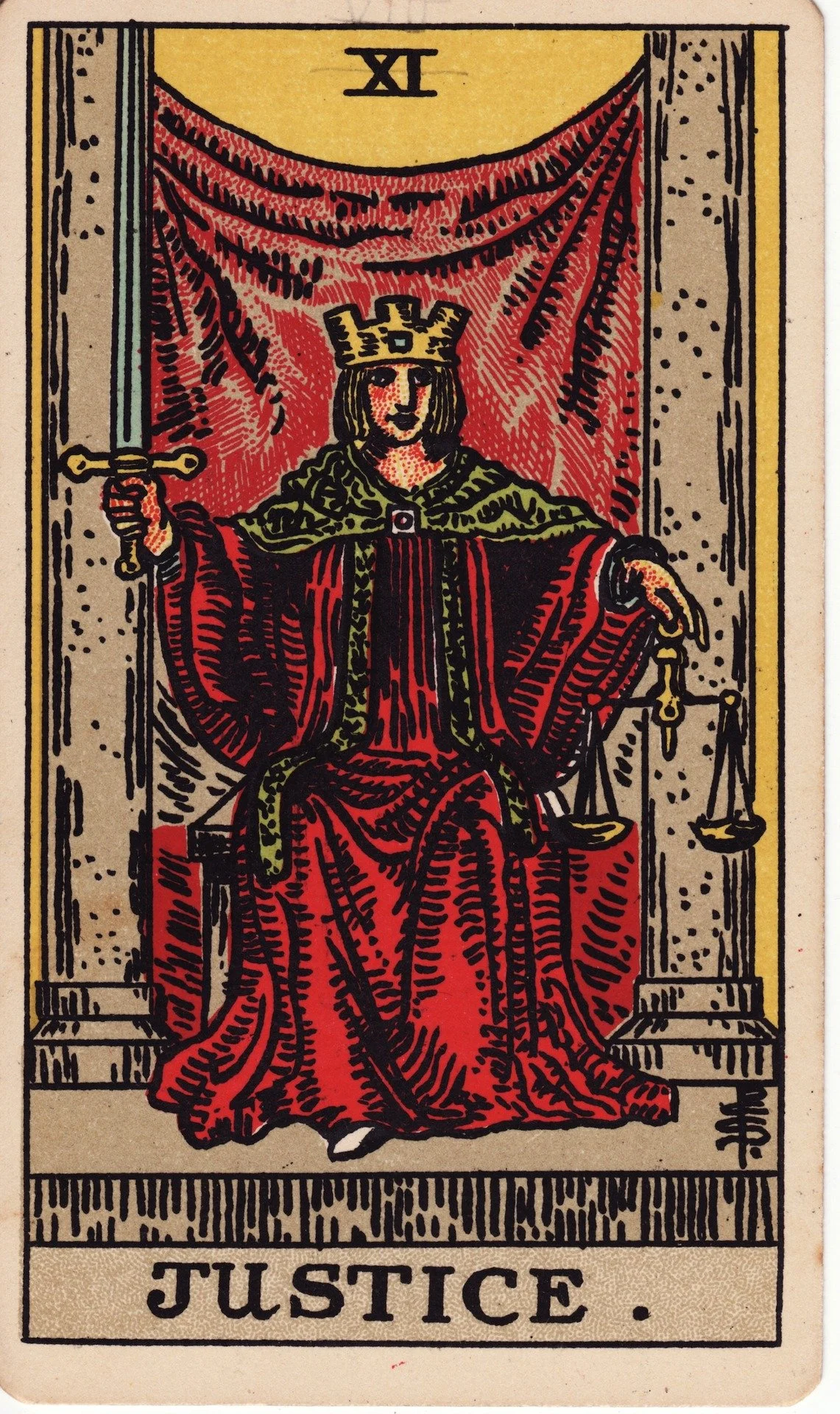
Justice
Justice is truth, balance, accountability, ethics, cause and effect, and the clean blade of reality. This card is what remains when excuses are removed. It asks for accuracy. What happened? What was chosen? What was avoided? What is fair? What is repair? Justice is not punishment first. It is right relationship with consequence.
Jungian profile: Justice is the archetype of the inner judge, the ethical function, and the discriminating mind. It is related to conscience, not shame. In a mature psyche, Justice helps a person tell the truth without collapsing into self hatred. It can weigh evidence, make amends, set boundaries, and act with integrity. In shadow, Justice becomes harsh judgement, moral perfectionism, legalistic thinking, revenge disguised as fairness, and the refusal to include context.
Positive attributes
- Integrity
- Accountability
- Fairness
- Discernment
- Truth telling
- Ethical clarity
- Repair
- Balanced judgement
- Honest consequence
- The ability to see your part without making it your entire identity
Negative attributes
- Harsh judgement
- Perfectionism
- Blame
- Self punishment
- Coldness
- Revenge
- Over rationalisation
- Legalism
- Using fairness to avoid compassion
- Demanding accountability from others while dodging your own
Psychologically, Justice asks what the person knows but has not admitted. It can bring relief because the truth is often simpler than the story built around avoiding it. This card is strong medicine for people who confuse guilt with accountability. Guilt can become self involved. Accountability moves. It tells the truth, names the impact, changes behaviour, and repairs where repair is possible. Justice also asks for boundaries because fairness without boundaries becomes self betrayal.
When Justice appears in an Energy Map, the person is coded for truth, consequence, ethics, discernment, fairness and correction. This is the clean mirror code. It shows where the map holder must learn to see clearly, choose honestly and accept the result of their choices. Justice has no interest in self-deception dressed as spirituality.
This placement often appears for people who are here to bring balance, accountability, advocacy, truth-telling, strategy or precise judgement into their lives and work. The gift is integrity. The shadow is harshness, moral superiority, over-analysis, punishment, legalistic thinking, scorekeeping, or delaying action until the “perfect” judgement is available. Justice reminds the person that every choice has a field effect.
If this appears as an attribute
- Character or comfort zone: you seek fairness, logic and moral clarity. Do not use analysis to avoid emotional honesty.
- Portrait or public self: people may see you as precise, balanced, intelligent, ethical, critical or hard to fool. Let compassion inform your judgement.
- Higher essence: your direction opens through truth, accountability, advocacy, contracts, ethics and decisions that restore balance.
- Heart or relationship point: love requires honesty, equality and repair. Stop keeping private ledgers and start having clean conversations.
- Material, work or prosperity point: money may come through law, admin, contracts, analytics, consulting, editing, mediation, finance, compliance, advocacy or decision-making roles.
- Ancestral or child-parent point: you may carry injustice, family judgement, unequal treatment, blame, punishment, divorce, legal issues or a need to prove innocence.
- Health map or chakra point: the body may respond to imbalance, stress from suppressed truth, jaw tension, kidneys, skin, hormones or nervous system strain from unresolved conflict.
What to do with it
- Tell the truth first to yourself, then to the relevant person.
- Look at the consequences without dramatizing them.
- Put agreements in writing.
- Stop confusing fairness with everyone being pleased.
- Repair what can be repaired. Release what requires self-betrayal.
- Ask: “What would be the cleanest next action?”
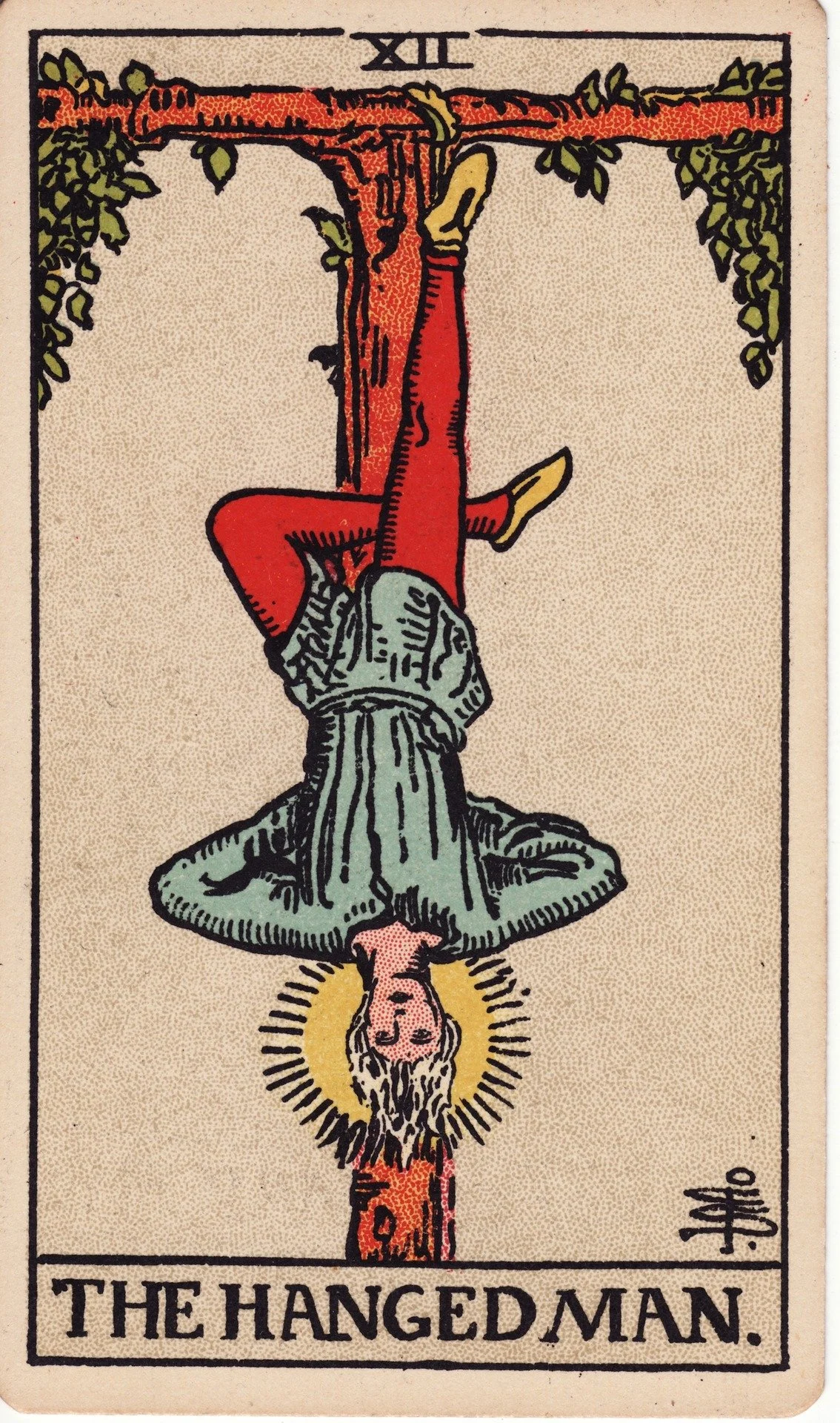
The Hanged Man
The Hanged Man is suspension, surrender, reversal, waiting, and the strange intelligence of not forcing movement. He is not stuck in the same way a trapped person is stuck. He has been turned upside down so another angle can become visible. This card asks for a pause that changes perception.
Jungian profile: The Hanged Man is the ego in symbolic sacrifice. The old stance cannot produce the next insight, so the psyche interrupts the usual posture. In Jungian language, this card often appears during liminal states where the conscious identity is being loosened. The person cannot solve the problem at the same level of perception that created it. The shadow is martyrdom, paralysis, passive suffering, learned helplessness, and calling avoidance 'surrender'.
Positive attributes
- Surrender
- Perspective
- Patience
- Spiritual humility
- Reframing
- Letting go
- Non reactive awareness
- Creative pause
- Willingness to be changed
- The ability to stop pushing when pushing has become the problem
Negative attributes
- Martyrdom
- Stagnation
- Victim identity
- Avoidance
- Passive suffering
- Indecision
- Romanticising pain
- Waiting for rescue
- Confusing surrender with giving up
- Using spirituality to avoid action
Psychologically, The Hanged Man asks what would become visible if the person stopped fighting the pause. This card often appears when the will is exhausted and the psyche needs a different mode. It is difficult for people who equate worth with movement. The pause can feel like failure, but it may actually be the first honest moment in the whole process. The Hanged Man also asks where the person has become attached to being the one who suffers. Sometimes the identity of sacrifice becomes more familiar than the freedom that follows release.
When The Hanged Man appears in an Energy Map, the person is coded for surrender, perspective change, suspension, sacrifice and altered perception. This is the reversal code. It shows where the map holder cannot force the next stage through effort alone. Something needs to be seen differently before it can move.
The Hanged Man often appears when a person has to pause, wait, release control, stop performing productivity, or let an old identity hang long enough to loosen. The gift is spiritual perception, patience and willingness to stop fighting reality. The shadow is martyrdom, paralysis, passivity, self-sacrifice, dissociation, or using surrender language to avoid making a difficult choice.
If this appears as an attribute
- Character or comfort zone: you may tolerate limbo better than action. Use the pause for insight, not as a permanent residence.
- Portrait or public self: people may see you as patient, strange, spiritual, hard to pin down or self-sacrificing. Be clear about what you are choosing.
- Higher essence: your direction opens through surrender, contemplation, altered perspective, service and seeing the world upside down.
- Heart or relationship point: love may involve waiting, sacrifice or changed perspective. Check whether you are being patient or abandoning yourself.
- Material, work or prosperity point: money may come through healing spaces, spiritual work, photography, art, crisis reflection, research, perspective-shifting, retreats or support roles.
- Ancestral or child-parent point: you may carry family martyrdom, suspended grief, sacrifice for survival, emotional waiting rooms, or people who could not act freely.
- Health map or chakra point: the body may ask for rest, lymphatic flow, nervous system downshifting, foot care, circulation support or release from chronic tension.
What to do with it
- Pause deliberately and set a review point. Endless limbo is not surrender.
- Ask what becomes visible when you stop trying to win.
- Release one role you keep playing to be seen as good.
- Let the body rest before you demand another answer.
- Practise saying, “I am unavailable for sacrifice disguised as love.”
- Turn the problem around. The opposite view may hold the key.
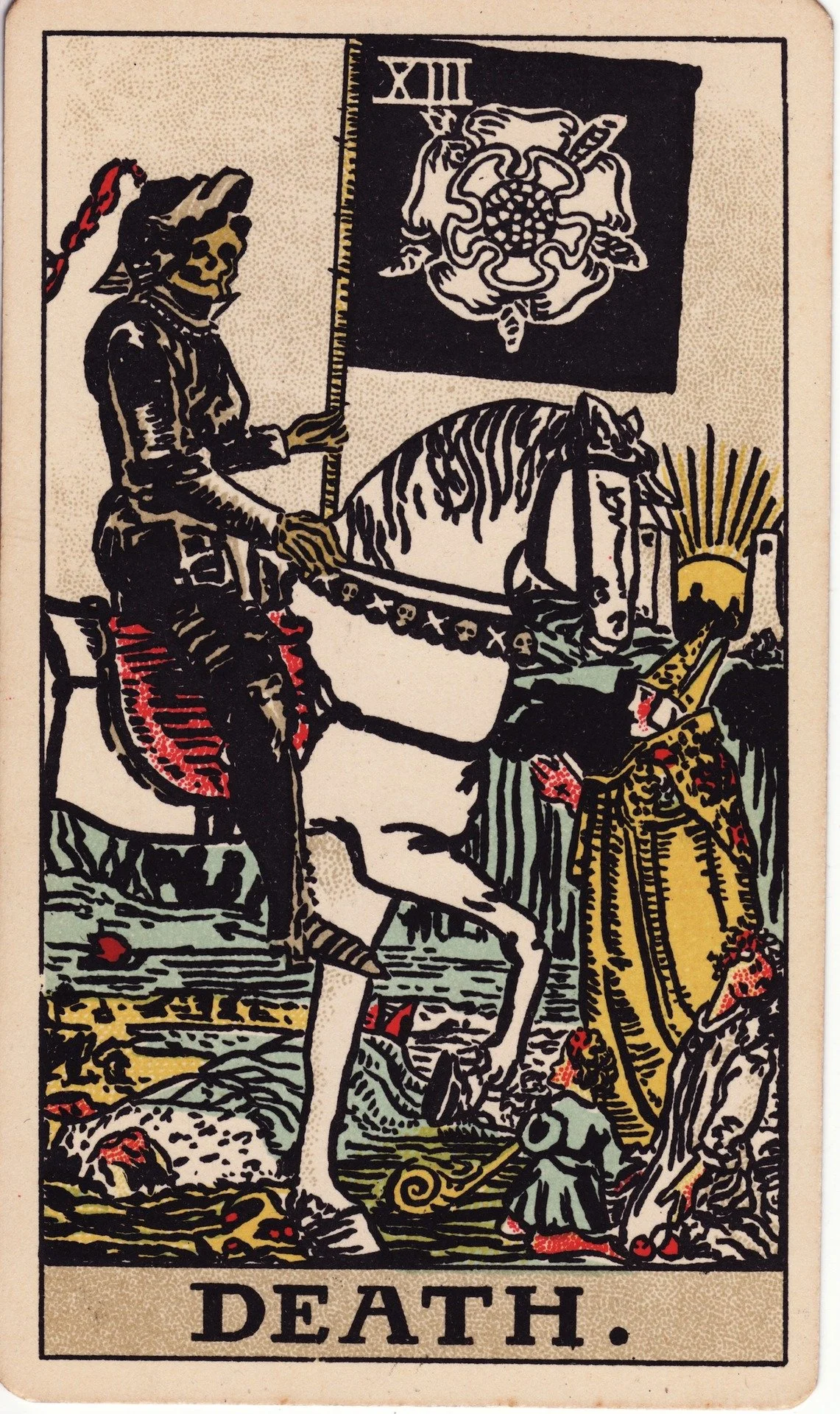
Death
Death is ending, release, completion, grief, transformation, and the dignity of letting something be over. It does not ask whether the ego likes the ending. It asks whether life has already moved. This card is the clean severing of what has expired.
Jungian profile: Death is the archetype of transformation through symbolic dying. It is central to individuation because the psyche cannot become more whole without losing false identities. In myths, descent and death often precede renewal. In the psyche, this card appears when an old self, old attachment, old role, old defence, or old future has reached its limit. Its shadow is clinging, numbness, destruction without reverence, or compulsive reinvention that avoids grief.
Positive attributes
- Release
- Transformation
- Closure
- Truth
- Grief work
- Clean endings
- Renewal after completion
- Letting the old self die
- Respect for cycles
- The ability to stop feeding what is already dead
Negative attributes
- Clinging
- Fear of loss
- Emotional numbness
- Destructive exits
- Avoidance of grief
- Dramatic reinvention
- Refusing closure
- Staying loyal to a corpse
- Using endings to punish
- Mistaking intensity for transformation
Psychologically, Death asks what the person is keeping alive with their attention. Many people do not fear endings as much as they fear the identity vacuum after the ending. Who am I if I am no longer the rescuer, the chosen one, the struggling one, the loyal one, the betrayed one, the potential one? Death strips away the role and asks for grief. Real transformation includes mourning. Without grief, the old form often returns in a new outfit.
When Death appears in an Energy Map, the person is coded for endings, transformation, release and irreversible change. This is the threshold code. It shows where the map holder is not here to preserve every version of themselves. Some identities, patterns, attachments, roles and environments have a natural expiry date.
Death is clean when the person respects endings. It becomes painful when the person keeps trying to animate what has already completed. The gift is transformation, honesty, renewal and deep psychological shedding. The shadow is fear of loss, clinging, emotional numbness, dramatic cutting off, obsession with change, or confusing destruction with transformation. Death asks for maturity around closure.
If this appears as an attribute
- Character or comfort zone: you know how to end things, or life keeps teaching you. Avoid becoming identified with crisis or constant reinvention.
- Portrait or public self: people may see you as intense, transformative, private, powerful, intimidating or changed by life. Let softness return after the ending.
- Higher essence: your direction opens through surrendering old forms and allowing the next self to emerge without dragging the corpse of the old one.
- Heart or relationship point: love may require endings, grief, honesty and rebirth. Stop using loyalty to avoid the truth of completion.
- Material, work or prosperity point: money may come through transformation work, crisis support, therapy, death care, trauma integration, endings, decluttering, strategy shifts or industries of renewal.
- Ancestral or child-parent point: you may carry grief, loss, inheritance themes, family silence around death, survival after rupture, or people who had to cut off parts of themselves.
- Health map or chakra point: the body may speak through elimination, reproductive themes, deep fatigue, detoxification patterns, grief held in tissue or symptoms that follow major endings.
What to do with it
- Name what has ended without negotiating with it for another year.
- Create closure rituals that involve the body, not only the mind.
- Grieve properly. Transformation without grief becomes performance.
- Remove objects, habits and obligations that keep the old identity alive.
- Stop confusing intensity with intimacy.
- Ask: “What am I still feeding that no longer has life in it?”
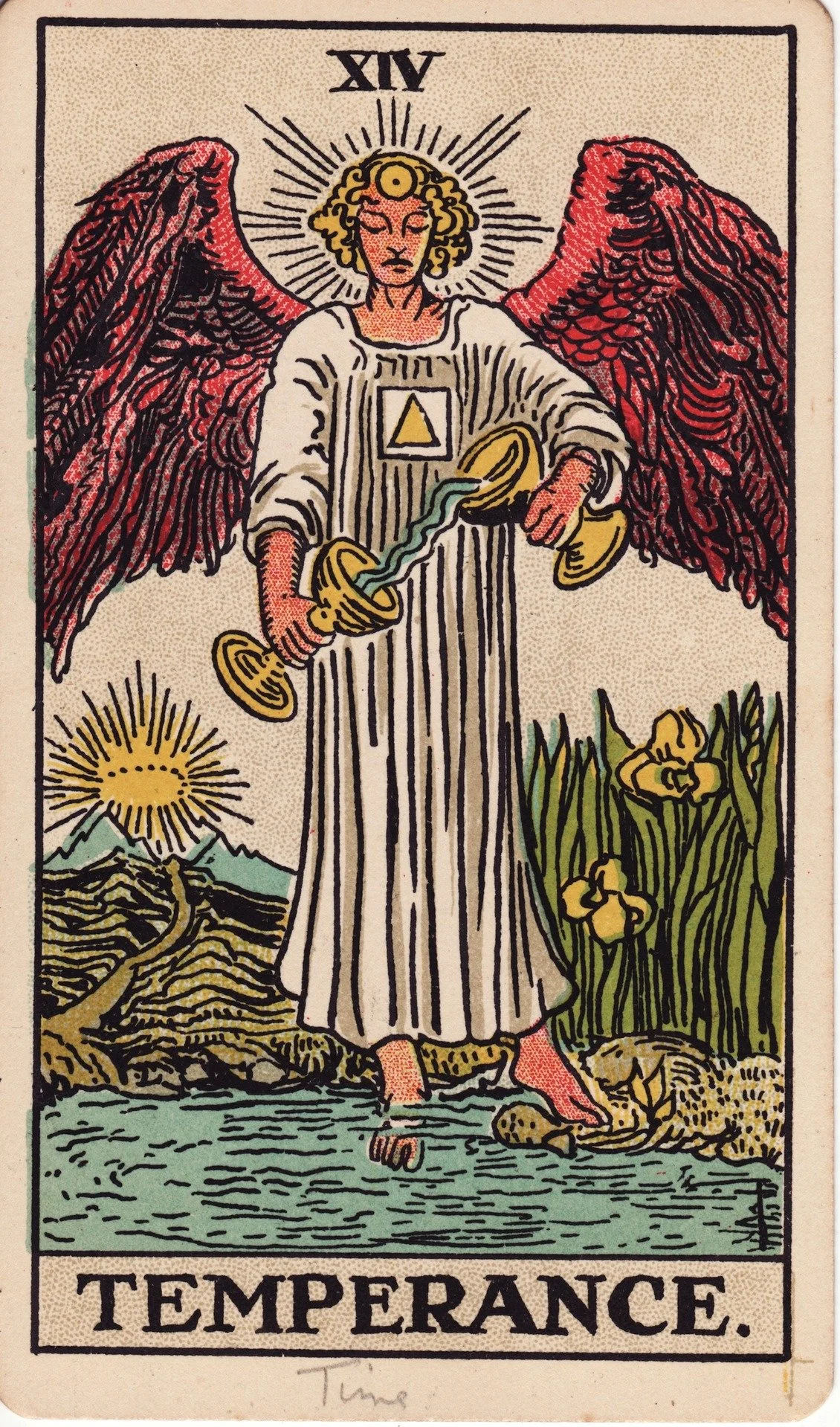
Temperance
Temperance is regulation, proportion, healing, moderation, and the slow art of mixing what once seemed separate. This card is not bland balance. It is alchemy through relationship. Water moves between vessels. The psyche learns how to combine difference without losing coherence.
Jungian profile: Temperance is the alchemist and the inner mediator. It works with opposites: spirit and body, instinct and ethics, grief and hope, desire and discipline, masculine and feminine, conscious and unconscious. In Jungian terms, this card belongs to integration. It is the psyche developing a third thing that neither side could create alone. Its shadow is over moderation, emotional dilution, conflict avoidance, and premature peace.
Positive attributes
- Integration
- Regulation
- Patience
- Adaptability
- Proportion
- Inner harmony
- Repair
- Subtle healing
- Relational intelligence
- The ability to blend opposing truths without collapsing either one
Negative attributes
- Avoidance
- Over compromise
- Emotional dilution
- Fear of extremes
- False peace
- Lack of conviction
- People pleasing
- Spiritual smoothing
- Taking too long to act
- Confusing regulation with making everything small
Psychologically, Temperance asks what needs to be metabolised slowly. Some material cannot be forced through the system. The person may need rhythm, titration, repetition, and gentleness. This is a strong card for nervous system work because it respects capacity. Too much truth too quickly can flood the body. Too much control can block the process. Temperance also asks for relational maturity. It is possible to hold two truths without betraying either one. That skill is rare and powerful.
When Temperance appears in an Energy Map, the person is coded for integration, moderation, blending, repair and energetic alchemy. This is the harmoniser code. It shows where the map holder is here to bring parts together that usually stay split: body and spirit, logic and intuition, intensity and softness, work and rest, grief and hope.
Temperance is the art of right proportion. The gift is healing through balance, refinement, patience and subtle adjustment. The shadow is dilution, avoidance of intensity, people-pleasing, chronic compromise, spiritual bypassing, or trying to make peace so quickly that the truth never gets fully spoken. Temperance does not mean blandness. It means precision in mixture.
If this appears as an attribute
- Character or comfort zone: you mediate, blend and calm. Make sure harmony is not costing you clarity.
- Portrait or public self: people may see you as balanced, healing, patient, gentle, diplomatic or restorative. Let your standards be visible.
- Higher essence: your direction opens through integration, subtle practice, energetic refinement, bridge-building and consistent calibration.
- Heart or relationship point: love requires balance, repair and emotional pacing. Avoid becoming the one who absorbs extremes so everyone else feels fine.
- Material, work or prosperity point: money may come through therapy, wellness, blending modalities, facilitation, design, homeopathy, mediation, hospitality, beauty, nutrition or integration work.
- Ancestral or child-parent point: you may carry family patterns around extremes, addiction, conflict avoidance, peacekeeping, mixed cultures, or being the emotional regulator.
- Health map or chakra point: the body may ask for hydration, hormonal balance, nervous system regulation, mineral support, digestion, liver care or consistent rhythm.
What to do with it
- Make small adjustments before life requires a dramatic correction.
- Practise balance as an active choice, not a vague ideal.
- Integrate one modality, lesson or insight into daily behaviour before adding another.
- Stop over-compromising with people who benefit from your flexibility.
- Use rhythm: same time, same practice, same promise to yourself.
- Ask: “What is the right proportion here?”
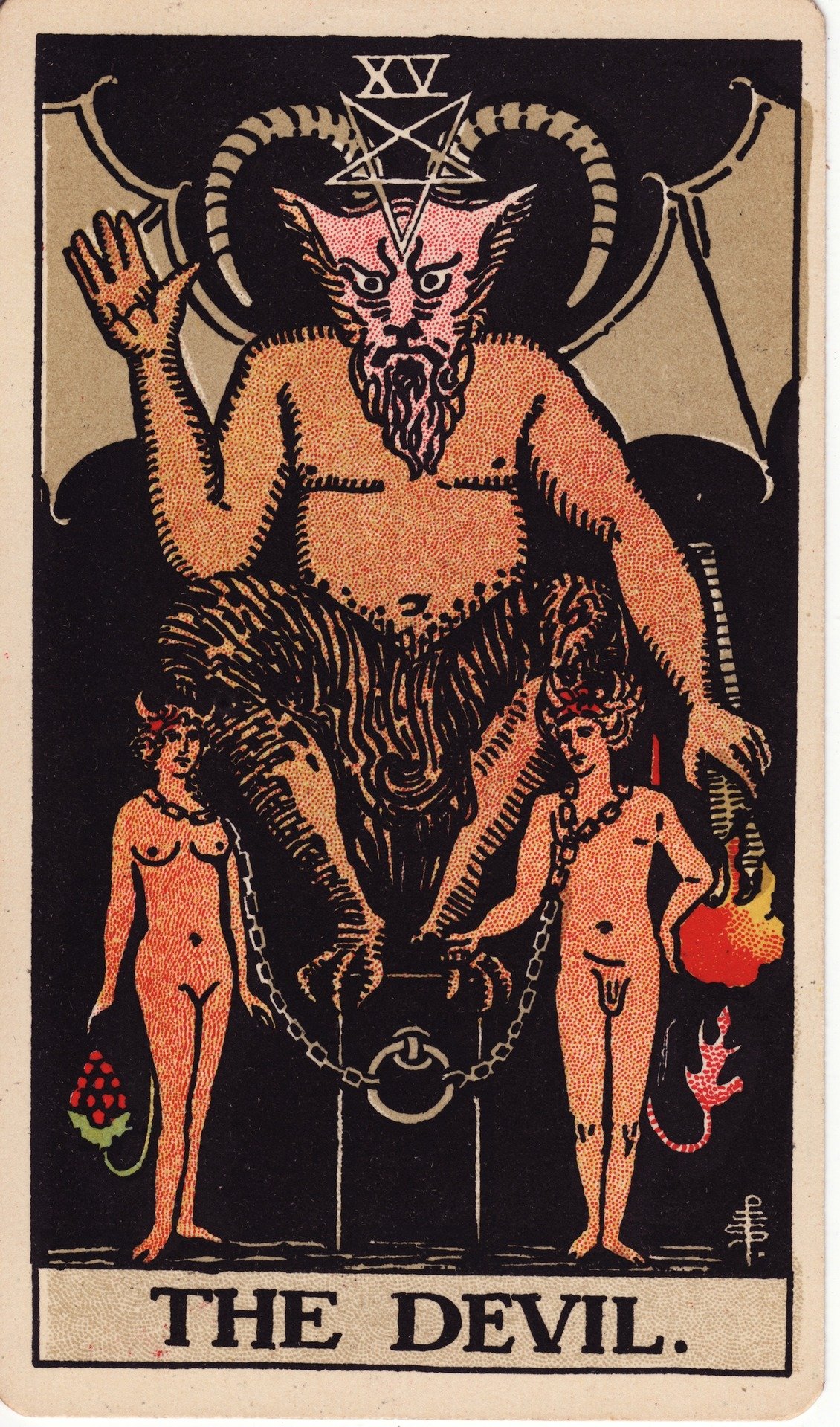
The Devil
The Devil is attachment, compulsion, temptation, shame, material fixation, and the places where the person has handed power to a chain that may be looser than it looks. This card is not evil as a personality. It is bondage as a pattern. It names what owns attention.
Jungian profile: The Devil is shadow material charged with instinct, shame, fear, desire, and denied power. It is the archetype of possession, where a complex takes over the personality and makes the person act against their own freedom. In the psyche, The Devil appears through addiction, obsession, sexual shame, money fear, body hatred, power games, secrecy, and repetitive choices that create short relief and long consequence. Its gift is brutal honesty. It shows where the person is not free.
Positive attributes
- Honesty about desire
- Shadow awareness
- Material intelligence
- Sensual power
- Naming the chain
- Reclaiming denied instinct
- Freedom through truth
- Capacity to face taboo
- Breaking compulsive contracts
- The ability to see where pleasure has become captivity
Negative attributes
- Addiction
- Compulsion
- Shame
- Obsession
- Control
- Secrecy
- Self sabotage
- Power games
- Material enslavement
- Calling the cage comfort because freedom feels too exposed
Psychologically, The Devil asks what the person gets from staying bound. That question can feel offensive because the conscious self may hate the pattern. But every repeated pattern has a function. It may provide numbness, identity, belonging, rebellion, control, erotic charge, financial excuse, or protection from disappointment. The Devil does not release through denial. It releases through contact with the exact bargain being made. The person has to admit the payoff before they can choose the cost differently.
When The Devil appears in an Energy Map, the person is coded for attachment, desire, taboo, material reality, compulsion and shadow honesty. This is the chain code. It shows where the map holder must stop pretending they are freer than they are. The Devil reveals the contracts people keep with fear, pleasure, shame, addiction, status, control, money, sex, resentment or old survival patterns.
The Devil is not a moral punishment card. It is the archetype of bondage through unconscious agreement. The gift is raw honesty, embodiment, desire, material power and the courage to face what has been disowned. The shadow is compulsion, self-sabotage, secrecy, obsession, shame loops, victim identity, power games or staying chained because the chain is familiar.
If this appears as an attribute
- Character or comfort zone: you may understand desire, power and survival deeply. Watch the part of you that chooses the familiar cage.
- Portrait or public self: people may see you as magnetic, intense, provocative, material, taboo-breaking or powerful. Use that charge consciously.
- Higher essence: your direction opens through shadow integration, truth about desire and reclaiming power from what controls you.
- Heart or relationship point: love may expose attachment patterns, jealousy, sexual charge, control, trauma bonds or fear of abandonment. Choose truth over intoxication.
- Material, work or prosperity point: money may come through taboo topics, luxury, psychology, sex education, addiction recovery, power dynamics, entertainment, finance, branding or shadow work.
- Ancestral or child-parent point: you may carry addiction, secrecy, shame, poverty fear, control, abuse of power, religious guilt or inherited beliefs that make pleasure dangerous.
- Health map or chakra point: the body may speak through cravings, hormones, skin, reproductive themes, inflammation, adrenal stress, jaw tension or symptoms linked to suppression and compulsion.
What to do with it
- Write down the chain plainly. Name the behaviour, payoff and cost.
- Stop spiritualising patterns that require practical intervention.
- Track where shame makes you secretive. Secrecy feeds the chain.
- Reclaim desire without obeying every impulse.
- Make one concrete change to the environment that supports the old pattern.
- Ask: “What do I keep choosing because it feels safer than freedom?”
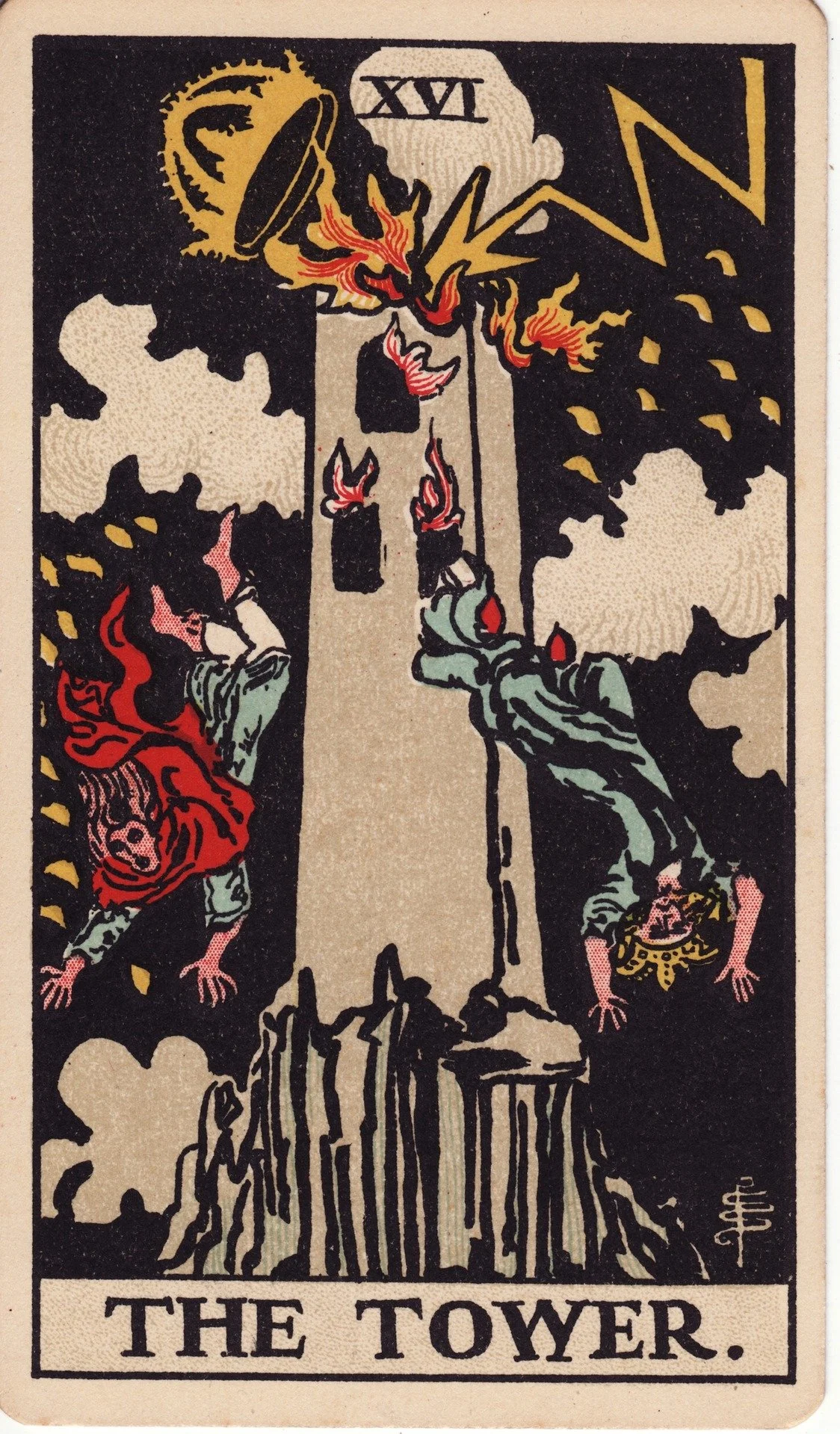
The Tower
The Tower is disruption, revelation, shock, collapse, and the removal of a structure that could not hold truth. It is the moment reality breaks through the architecture of denial. This card is rarely comfortable. It is often necessary. What falls was usually already unstable.
Jungian profile: The Tower is archetypal eruption. The unconscious, fate, truth, or consequence breaks through the ego's defensive structure. In Jungian terms, this can happen when a persona has become too rigid, when the conscious life is built against the soul, or when a complex can no longer be contained. The shadow is chaos addiction, crisis identity, destructive rebellion, and calling every inconvenience a Tower because intensity feels meaningful.
Positive attributes
- Revelation
- Liberation
- Truth breaking through
- Necessary collapse
- Disruption of denial
- Awakening
- Clearing false structures
- Radical honesty
- Freedom after impact
- The ability to rebuild from what is real
Negative attributes
- Chaos
- Destruction
- Crisis addiction
- Reactivity
- Humiliation
- Defensiveness
- Fear of instability
- Burning everything down
- Refusing earlier warnings
- Making collapse necessary because honesty was delayed
Psychologically, The Tower asks which structure was being protected at the expense of truth. It may be a relationship, identity, belief system, business, coping mechanism, family role, or spiritual narrative. The shock is often not the first signal. It is the signal that could no longer be ignored. The Tower also reveals what survives. After impact, the person often discovers which parts of them were never dependent on the false structure in the first place.
When The Tower appears in an Energy Map, the person is coded for disruption, revelation, collapse and forced liberation. This is the false-structure code. It shows where life will not let the map holder keep building on foundations that cannot hold truth. The Tower removes what ego, fear or conditioning tried to preserve.
This card often appears where a person experiences sudden realisations, ruptures, endings, exposure, nervous system shocks or dramatic awakenings. The gift is liberation, honesty and structural correction. The shadow is chaos, crisis addiction, defensiveness, refusal to listen until life gets loud, or burning everything down because one part of the structure is rotten. The Tower asks for humility before collapse becomes necessary.
If this appears as an attribute
- Character or comfort zone: you may provoke truth or live close to rupture. Learn to change earlier, before life has to shout.
- Portrait or public self: people may see you as disruptive, electrifying, confronting, honest, unstable or catalytic. Bring grounding to your impact.
- Higher essence: your direction opens through revelation, truth, dismantling false identities and rebuilding from reality.
- Heart or relationship point: love may expose false agreements, hidden resentment or structures built to avoid vulnerability. Tell the truth before the roof comes off.
- Material, work or prosperity point: money may come through crisis management, innovation, renovation, restructuring, technology, activism, emergency response, truth-telling or disruptive creativity.
- Ancestral or child-parent point: you may carry sudden loss, family collapse, unstable homes, secrets exposed, displacement, explosive conflict or inherited fear of safety disappearing.
- Health map or chakra point: the body may speak through nervous system shocks, migraines, accidents, inflammation, insomnia, trauma responses or symptoms triggered by suppressed truth.
What to do with it
- Identify the structure that already feels unstable. Start there.
- Tell the truth in pieces before it erupts as crisis.
- Create grounding after revelations: food, water, sleep, body contact, practical support.
- Do not romanticise chaos. Rebuild cleanly.
- Let collapse reveal the facts, then make decisions from the facts.
- Ask: “What is life trying to remove because I would not remove it myself?”
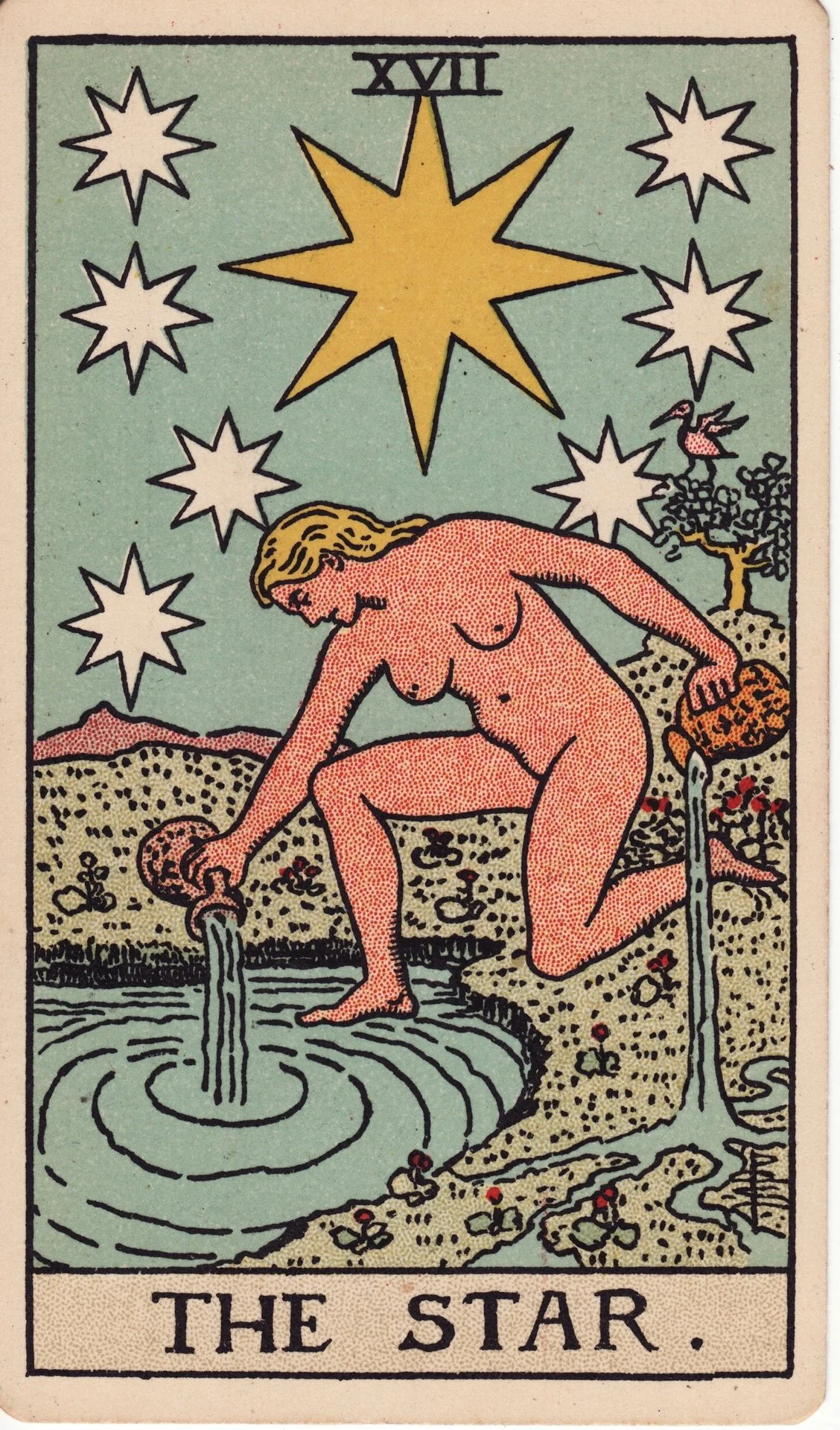
The Star
The Star is hope, restoration, honesty, spiritual freshness, and the quiet moment after survival when the person can feel life again. It is not loud optimism. It is the first clean breath after the system has been through too much. This card is nakedness without performance.
Jungian profile: The Star is the archetype of renewal after breakdown. It belongs to the psyche's capacity to reorient toward meaning after disillusionment. The figure is exposed, but not ashamed. In Jungian language, this can be the Self offering a guiding image after the ego has lost its old certainty. The shadow is passive wishing, spiritual bypassing through hope, aesthetic vulnerability, and refusing the practical work of repair.
Positive attributes
- Hope
- Renewal
- Authenticity
- Gentle trust
- Spiritual openness
- Transparency
- Emotional repair
- Creative inspiration
- Grace after collapse
- The ability to believe again without becoming naive
Negative attributes
- Naivety
- Passive wishing
- Avoiding practical repair
- Performative vulnerability
- Escapist spirituality
- Waiting for rescue
- Fragile optimism
- Ignoring material reality
- Using hope to avoid grief
- Wanting the blessing without the integration
Psychologically, The Star asks whether the person can receive life after disappointment. This is harder than people admit. After betrayal, collapse, grief, or burnout, the body can become suspicious of ease. Hope may feel unsafe because hope once preceded pain. The Star does not force positivity. It restores the person's relationship with possibility through small acts of truth, beauty, water, rest, and openness. It also asks for nakedness: what remains when the performance is gone?
When The Star appears in an Energy Map, the person is coded for renewal, hope, inspiration, visibility and spiritual restoration. This is the blessing-after-rupture code. It often appears after Tower-like experiences, when the person has been stripped back enough to receive clean light again. The Star is the psyche remembering possibility without forcing it.
This placement can show a person who brings calm, beauty, future vision, creative inspiration or a restorative field to others. The gift is faith, authenticity, tenderness, creative flow and the courage to be seen without armour. The shadow is fantasy, spiritual escapism, waiting for rescue, overexposure, saviour projection, or believing hope means avoiding the practical repair work.
If this appears as an attribute
- Character or comfort zone: you orient toward hope, beauty and future possibility. Keep your feet involved in the vision.
- Portrait or public self: people may see you as inspiring, ethereal, healing, visible, creative or calming. Let your realness be part of the light.
- Higher essence: your direction opens through authenticity, creative expression, restoration, prayer, community hope and long-range vision.
- Heart or relationship point: love requires vulnerability and honest visibility. Stop making yourself unreachable to stay idealised.
- Material, work or prosperity point: money may come through creativity, social media, astrology, wellness, beauty, inspiration, public presence, humanitarian work, water, art or future-facing spaces.
- Ancestral or child-parent point: you may carry patterns around lost hope, exile, being unseen, family dreams deferred, or becoming the one who restores faith after hardship.
- Health map or chakra point: the body may ask for hydration, sleep, skin support, nervous system restoration, gentle movement, breath, or recovery after stress.
What to do with it
- Let hope become a practice, not a mood.
- Create something in public before it feels perfect.
- Water the body and the future: hydration, rest, beauty, vision, consistency.
- Stop confusing being admired with being known.
- Use your visibility to transmit honesty, not unreachable perfection.
- Ask: “What part of me is ready to believe in life again?”
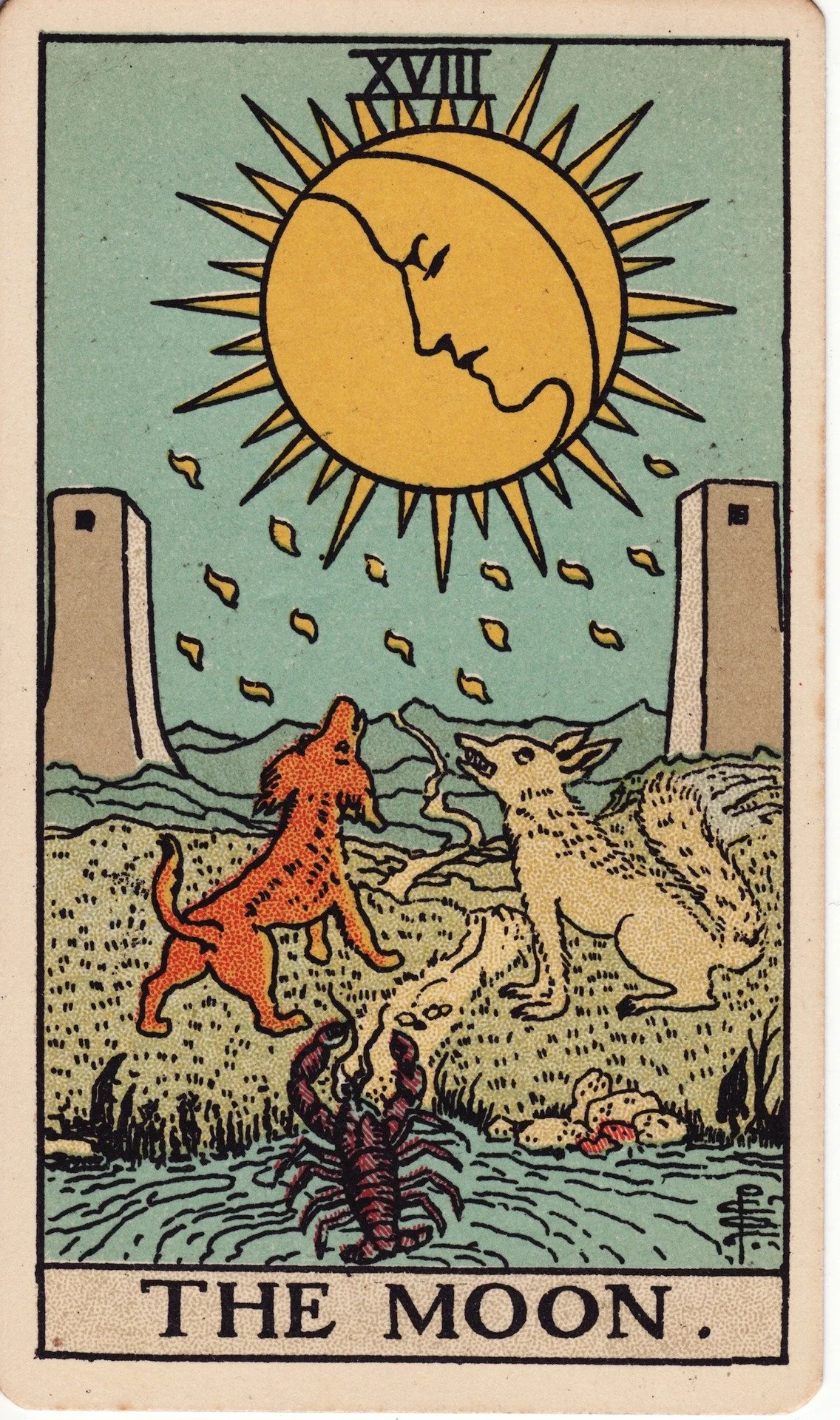
The Moon
The Moon is unconscious material, dreams, fear, illusion, instinct, projection, and the strange landscape where things are felt before they are understood. It is the night path. Shapes look different here. The person must move carefully because not every feeling is a fact, and not every fear is false.
Jungian profile: The Moon is the realm of the unconscious in its seductive, frightening, fertile form. It is anima waters, dream imagery, ancestral residue, instinctual memory, and psychic material rising in symbolic form. In a psyche, it appears when projection is strong and certainty is weak. The Moon can bring intuition, but it can also bring distortion. Its shadow is paranoia, fantasy, emotional flooding, deception, and mistaking the contents of the unconscious for objective reality.
Positive attributes
- Dream awareness
- Intuition
- Symbolic depth
- Sensitivity
- Imagination
- Instinct
- Mystery tolerance
- Ancestral awareness
- Emotional truth
- The ability to stay with uncertainty without forcing false clarity
Negative attributes
- Illusion
- Projection
- Paranoia
- Confusion
- Self deception
- Emotional flooding
- Fantasy attachment
- Avoiding facts
- Fear based interpretation
- Calling every feeling a message because reality feels too plain
Psychologically, The Moon asks what the person is projecting onto the path. Projection is not stupidity. It is the psyche putting internal material onto an external screen so it can be seen. The work is to retrieve the projection without shaming it. The Moon is also important for trauma patterns because the body may respond to current events as though old danger is present. This card asks for slowness. Gather evidence. Track dreams. Notice repetition. Do not make major meaning out of a dysregulated moment.
When The Moon appears in an Energy Map, the person is coded for the unconscious, dreams, instinct, illusion, emotional tides and psychic sensitivity. This is the night-path code. It shows where the map holder must learn to move without full certainty. The Moon does not offer clean daylight. It offers symbols, feelings, memories, fears, fantasies and strange knowing.
This card often appears for people with strong imaginal lives, deep sensitivity, ancestral memory, dream activity, psychic impressions or emotional patterning that comes from early life. The gift is depth perception, creativity, empathy and contact with the hidden psyche. The shadow is confusion, projection, paranoia, avoidance, self-deception, emotional flooding, or trusting every feeling as fact.
If this appears as an attribute
- Character or comfort zone: you feel your way through life. Learn to honour feeling without letting it become the only evidence.
- Portrait or public self: people may see you as mysterious, dreamy, sensitive, artistic, psychic, hard to read or changeable. Ground the signal.
- Higher essence: your direction opens through dream work, subconscious patterning, creativity, ancestral inquiry and learning to walk through uncertainty.
- Heart or relationship point: love may activate projection, longing, fear or old attachment material. Ask what belongs to now and what belongs to then.
- Material, work or prosperity point: money may come through art, film, photography, music, psychology, sleep, dreams, oceans, women’s cycles, subconscious work, mystery or intuitive practice.
- Ancestral or child-parent point: you may carry family secrets, emotional instability, hidden fear, addiction, maternal line patterns, unprocessed grief or inherited anxiety.
- Health map or chakra point: the body may speak through sleep, hormones, lymph, fluids, digestion, anxiety, sensory sensitivity, headaches or cyclical symptoms.
What to do with it
- Track dreams, fears and repeated emotional weather without immediately believing the story.
- Check feelings against facts, time and body evidence.
- Reduce overstimulation before making meaning.
- Work with the subconscious through writing, sound, ritual, therapy, art or gentle repetition.
- Ask whether a reaction is proportionate to the present moment.
- Move slowly when the path is foggy. Slow is still movement.
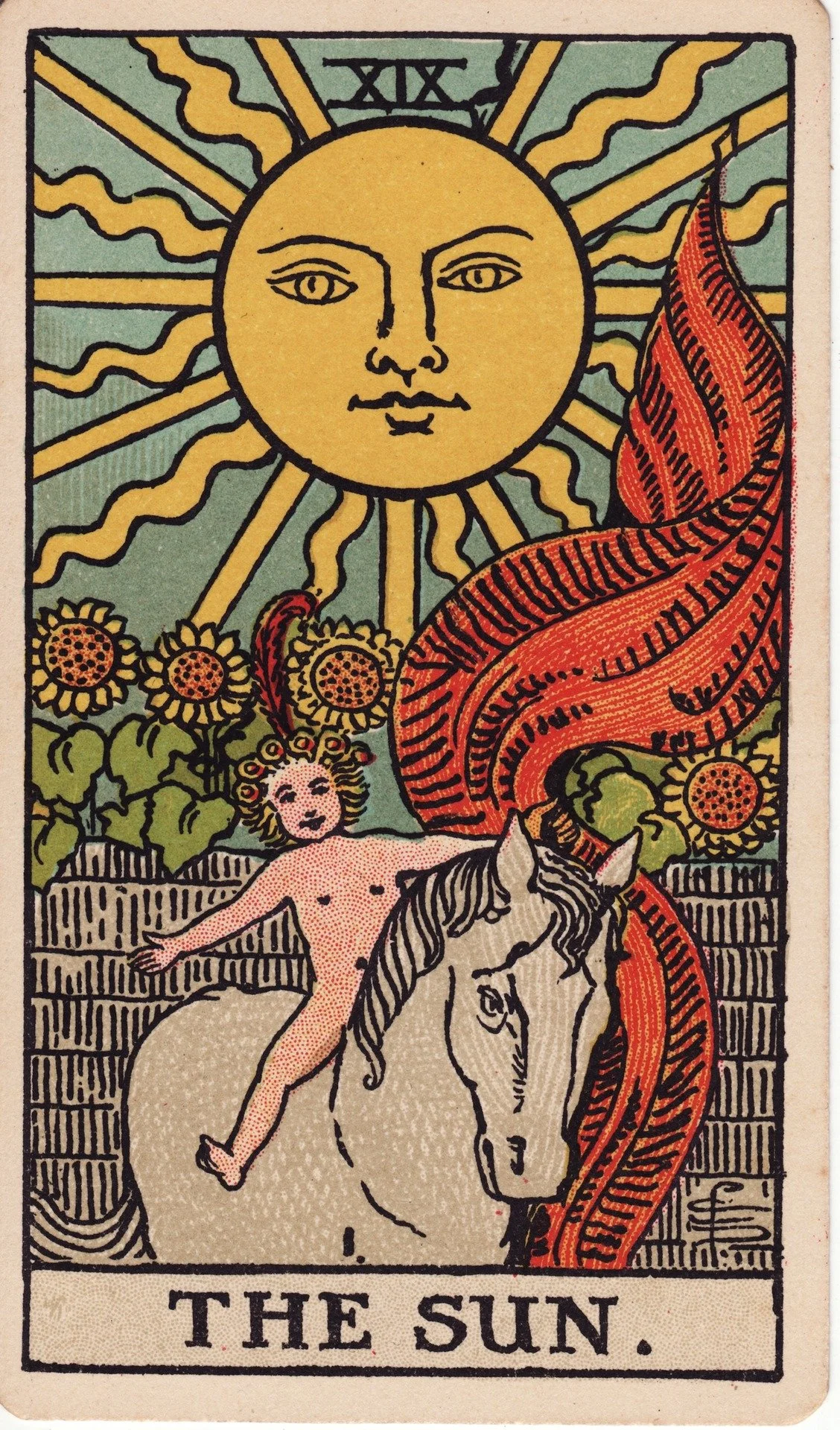
The Sun
The Sun is clarity, vitality, joy, confidence, visibility, warmth, and the return of uncomplicated life force. It is the psyche under direct light. What is true can be seen. What is alive can grow. The Sun is simple, but not shallow. It is the relief of not needing to hide.
Jungian profile: The Sun is conscious illumination, healthy ego strength, the divine child, and the life principle made visible. In a psyche, this archetype appears when the person can inhabit themselves without apology. It is confidence after integration, not performance confidence. The Sun also connects to the child self in its alive, playful, radiant form. Its shadow is ego inflation, childish entitlement, forced positivity, exposure without boundaries, and the fear of being ordinary once the spotlight fades.
Positive attributes
- Clarity
- Joy
- Vitality
- Visibility
- Confidence
- Play
- Healthier ego
- Warmth
- Creative expression
- The ability to be seen without turning visibility into performance
Negative attributes
- Ego inflation
- Naivety
- Attention seeking
- Forced positivity
- Entitlement
- Overexposure
- Avoiding shadow
- Performing happiness
- Fear of losing attention
- Confusing visibility with self worth
Psychologically, The Sun asks whether the person can tolerate being seen in their real brightness. Some people fear failure. Others fear visibility because visibility invites envy, expectation, judgement, and responsibility. The Sun also exposes the difference between joy and stimulation. Joy is stabilising. Stimulation often demands repetition. When The Sun is healthy, the person can enjoy life without needing to prove that the enjoyment means something profound.
When The Sun appears in an Energy Map, the person is coded for vitality, visibility, joy, confidence and clear expression. This is the radiance code. It shows where the map holder is meant to become more visible, more honest, more alive and less apologetic about existing. The Sun brings things into the open so life can organise around what is true.
This placement can show charisma, creative confidence, leadership, playfulness, childlike openness and strong life force. The shadow is entitlement, overexposure, arrogance, forced positivity, childishness, attention-seeking, burnout from constant brightness, or fear of being ordinary when the spotlight is gone. The Sun is healthiest when confidence is clean rather than performative.
If this appears as an attribute
- Character or comfort zone: you are built for openness, joy and expression. Watch the pressure to be “on” when you need rest.
- Portrait or public self: people may see you as bright, confident, warm, talented, visible, playful or successful. Let depth live beside brightness.
- Higher essence: your direction opens through visibility, creativity, truth, joy, leadership and letting yourself be fully seen.
- Heart or relationship point: love needs warmth, honesty and play. Avoid turning the relationship into an audience or a validation source.
- Material, work or prosperity point: money may come through visibility, performance, children, creativity, leadership, education, entertainment, branding, content or confidence-based work.
- Ancestral or child-parent point: you may carry patterns around visibility, golden child roles, neglected joy, pressure to shine, or family discomfort with confidence.
- Health map or chakra point: the body may speak through energy levels, heart, spine, eyes, vitamin D needs, inflammation, burnout or solar plexus themes.
What to do with it
- Put your work where it can be seen.
- Practise joy as a serious regulation tool.
- Let yourself be praised without shrinking or performing harder.
- Rest before brightness becomes a mask.
- Heal the part of you that equates visibility with danger.
- Ask: “What would I do if I trusted my own light?”
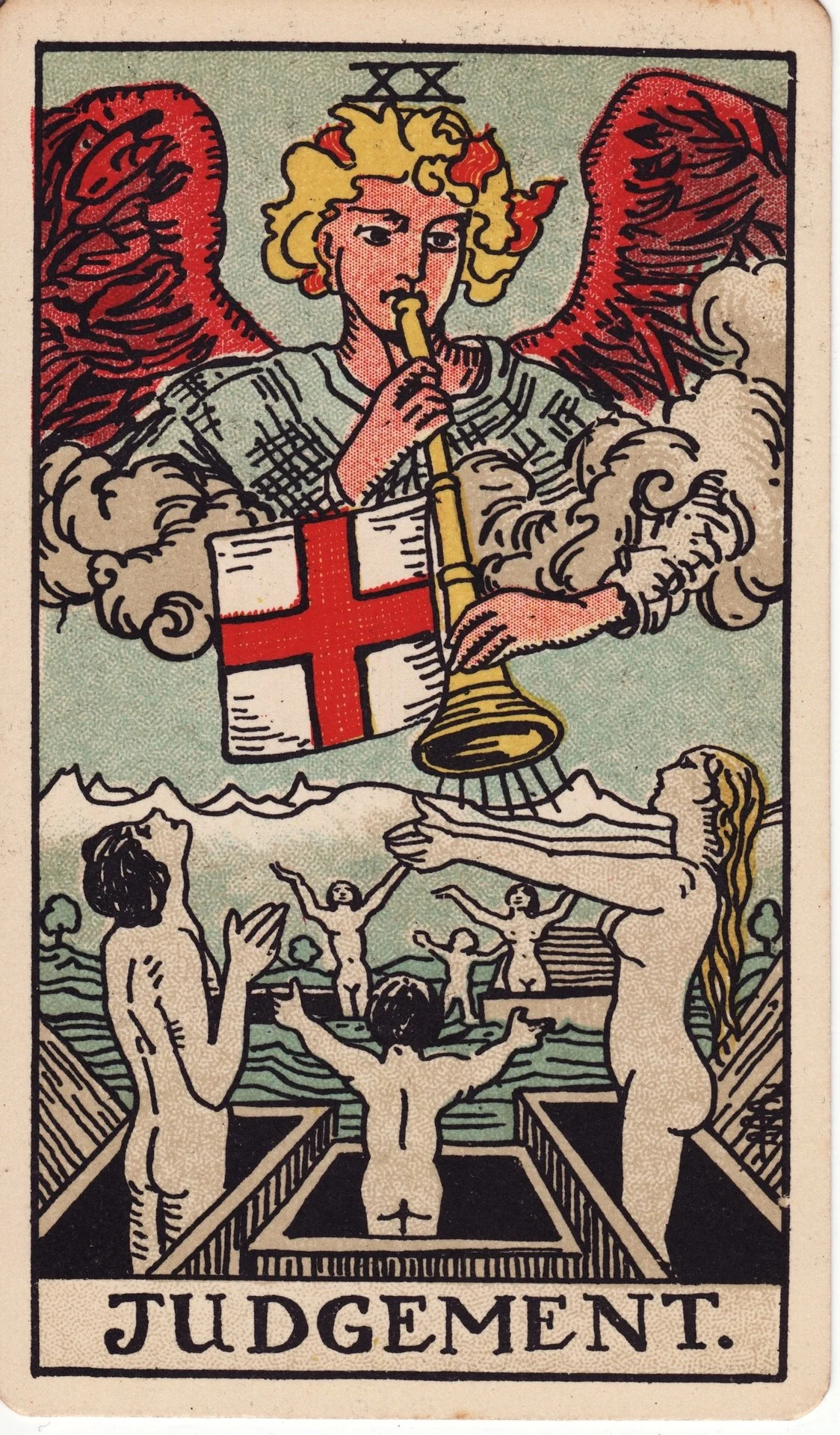
Judgement
Judgement is awakening, reckoning, calling, review, forgiveness, and the moment a person can no longer pretend they did not hear the summons. This card is not casual self improvement. It is a deep call to rise into a truer life, often after a long period of avoidance, sleep, shame, or rehearsal.
Jungian profile: Judgement is the archetype of resurrection and the call of the Self. It is the moment the ego hears something larger than preference. In individuation, this card appears when the person is being asked to answer to the whole life, not just the personality's comfort. It can involve ancestral material, life review, moral inventory, forgiveness, and the recovery of a buried vocation. Its shadow is harsh self condemnation, grandiosity about a 'calling', spiritual urgency, and using rebirth language to avoid repair.
Positive attributes
- Awakening
- Accountability
- Calling
- Forgiveness
- Life review
- Moral courage
- Renewal
- Answering the soul
- Releasing old shame
- The ability to rise without denying what happened
Negative attributes
- Self condemnation
- Grandiosity
- Urgency
- Spiritual pressure
- Avoiding repair
- Judging others
- Drama around rebirth
- Shame spirals
- Using a calling to feel superior
- Wanting resurrection without confession
Psychologically, Judgement asks what part of the person is ready to stop sleeping. The answer may be uncomfortable because sleep has benefits. It protects against grief, responsibility, desire, and the risk of trying. This card often arrives when an old identity has run out of moral oxygen. The person has to review the life without drowning in shame. Shame says, 'I am bad.' Judgement says, 'Wake up, tell the truth, and live differently.' That distinction matters.
When Judgement appears in an Energy Map, the person is coded for awakening, reckoning, calling and self-review. This is the resurrection code. It shows where the map holder must answer to the deeper life trying to call them forward. Judgement brings the past up, not to punish the person, but to integrate what has been avoided, denied, buried or outgrown.
This placement often appears for people with a strong sense of calling, legacy, spiritual responsibility, ancestral healing, voice, public truth or a major before-and-after life pattern. The gift is awakening, discernment and liberation from old identity. The shadow is self-condemnation, fear of being judged, grandiosity around calling, avoidance of accountability, or endlessly reviewing the past without responding to the call.
If this appears as an attribute
- Character or comfort zone: you self-review deeply and sense when a chapter is being called forward. Do not turn reflection into self-punishment.
- Portrait or public self: people may see you as awakening, intense, purposeful, prophetic, honest or transformational. Keep your message grounded.
- Higher essence: your direction opens through answering the call, using your voice, integrating the past and living from a clearer level of truth.
- Heart or relationship point: love may trigger reckoning, forgiveness, confession or a need to stop repeating old roles. Say what has been unsaid.
- Material, work or prosperity point: money may come through public speaking, voice work, coaching, therapy, legal or ethical review, spiritual teaching, legacy work, reinvention or second-chance offers.
- Ancestral or child-parent point: you may carry family guilt, unresolved endings, silence, judgement, exile, religious fear, ancestral calling or the need to break a long pattern.
- Health map or chakra point: the body may speak through the throat, ears, lungs, nervous system, immune response or symptoms that flare when truth is suppressed.
What to do with it
- Review the past for information, not for endless sentencing.
- Answer the call with one concrete commitment.
- Use your voice where silence has become complicity.
- Separate accountability from shame.
- Forgive what can be forgiven without pretending it had no impact.
- Ask: “What version of me is being summoned now?”
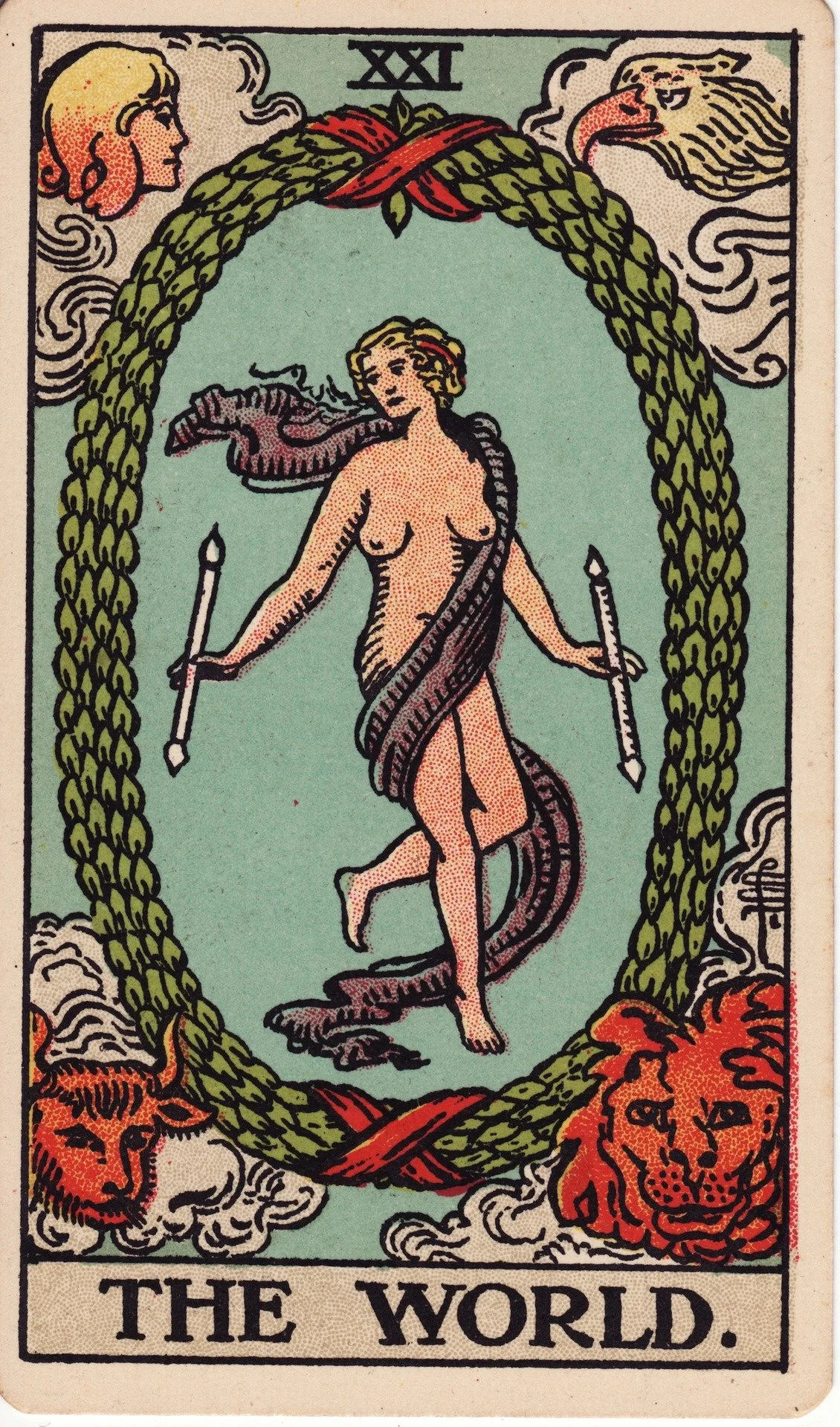
The World
The World is completion, integration, mastery, embodiment, wholeness, and the moment a cycle becomes complete enough to be lived from rather than chased. This card is not perfection. It is coherence. The pieces have found a rhythm. The person is inside the life, not standing outside it imagining the life.
Jungian profile: The World is the Self as mandala, the archetype of wholeness, and the psyche's image of integrated life. It holds the four functions, the body, the elements, the directions, and the full circle of experience. In individuation, The World does not mean there is no more growth. It means a cycle of growth has become embodied. Its shadow is false completion, spiritual achievement identity, fear of beginning again, and refusing to leave the finished room.
Positive attributes
- Completion
- Integration
- Embodiment
- Mastery
- Wholeness
- Coherence
- Celebration
- Belonging to life
- Cycle completion
- The ability to inhabit what you have become
Negative attributes
- Complacency
- False completion
- Achievement identity
- Fear of starting again
- Perfectionism
- Stagnation
- Using completion as status
- Avoiding the next threshold
- Feeling empty after success
- Confusing wholeness with being finished forever
Psychologically, The World asks whether the person can receive completion. This is surprisingly difficult. Some people are addicted to becoming and feel lost when the chase ends. Others sabotage completion because finished work can be judged, sold, seen, or released. The World is the embodiment test. Has the lesson changed behaviour, or does it only sound good when spoken? Integration is not a mood. It is a lived pattern.
When The World appears in an Energy Map, the person is coded for completion, integration, mastery and full-cycle embodiment. This is the wholeness code. It shows where the map holder is here to bring scattered parts into a complete form. The World is not about perfection. It is about enough integration for the next level to begin cleanly.
This placement can show someone with global perspective, mature synthesis, multi-disciplinary ability, travel themes, completion work, embodiment and a capacity to hold complexity. The gift is integration, fulfilment and embodied wisdom. The shadow is incompletion, perfectionism, fear of closure, always seeking the next thing, or never letting success land in the body.
If this appears as an attribute
- Character or comfort zone: you seek completion and coherence. Watch the habit of delaying completion because it is not perfect.
- Portrait or public self: people may see you as accomplished, worldly, integrated, capable, complete or hard to categorise. Own your range without over-explaining it.
- Higher essence: your direction opens through mastery, embodiment, completion, travel, synthesis and sharing integrated work with the wider world.
- Heart or relationship point: love asks for wholeness, not fusion. Bring your whole self without asking the other person to complete you.
- Material, work or prosperity point: money may come through global work, completion services, publishing, integration, education, travel, embodiment, systems, operations or bringing many parts into one cohesive offer.
- Ancestral or child-parent point: you may carry unfinished family cycles, migration, displacement, legacy completion, or the task of integrating what previous generations had to split apart.
- Health map or chakra point: the body may ask for full-system integration: movement, fascia, circulation, nervous system rhythm, sleep, embodiment and recovery after long effort.
What to do with it
- Finish what is already 80 percent complete.
- Let success register in the body before chasing the next milestone.
- Create rituals for completion, celebration and closure.
- Bring your separate skills into one coherent framework.
- Stop making “almost finished” your identity.
- Ask: “What wants to become whole now?”
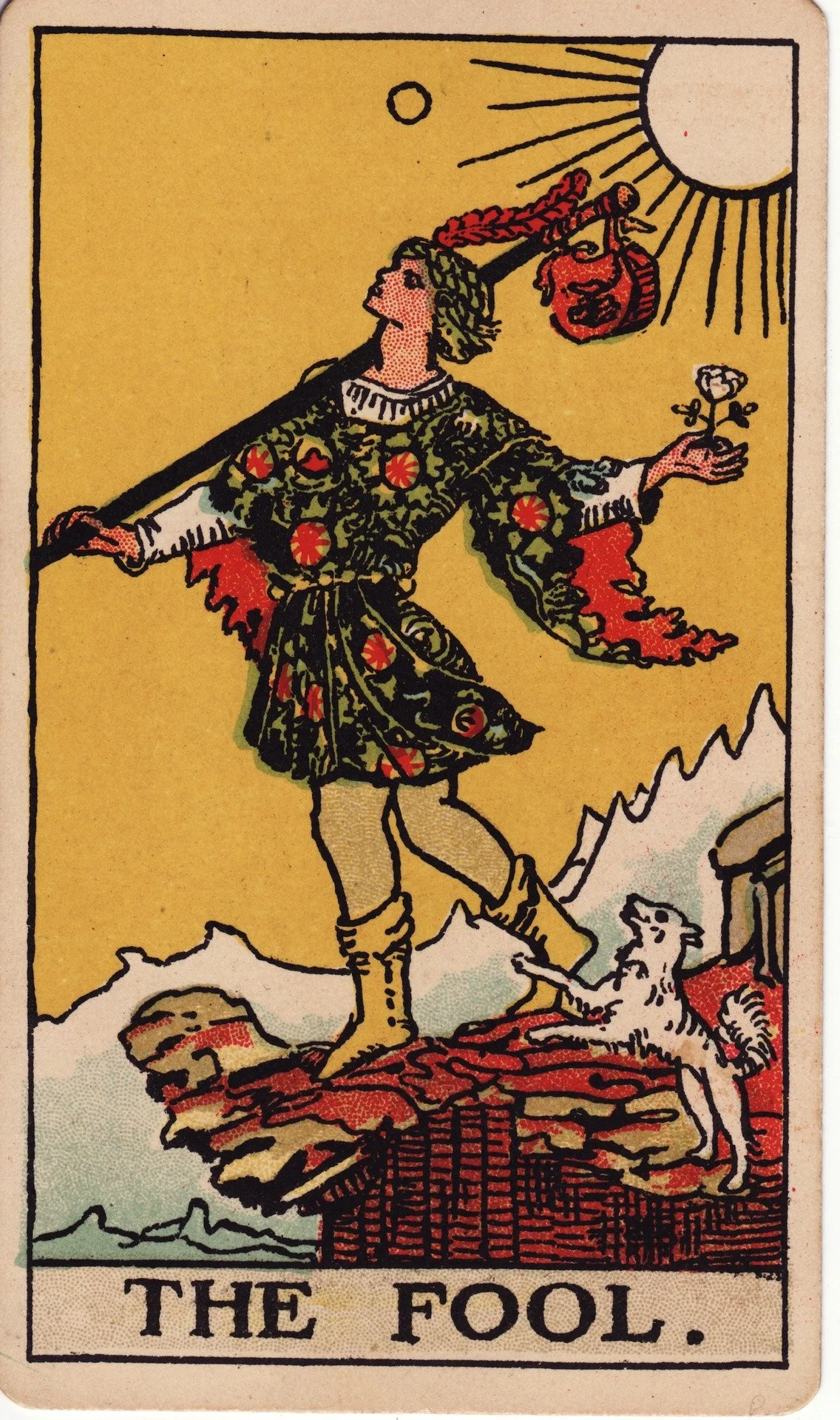
The Fool
The Fool is the open threshold, the leap, the beginner, the innocent, the wanderer, and the part of the self that can move before certainty arrives. In this system, The Fool is card 22, not card 0. That matters. The Fool is not placed before experience as blank innocence. The Fool arrives after The World as the next beginning after a completed cycle. This is not ignorance. This is earned openness.
Jungian profile: The Fool is the divine child, the trickster, the holy innocent, and the part of the psyche that remains alive beyond achievement. He carries the capacity to begin again after mastery, loss, integration, or completion. In individuation, The Fool protects the person from becoming too identified with the finished self. He reintroduces play, risk, wonder, and contact with the unknown. His shadow is naivety, avoidance of responsibility, reckless freedom, refusal to learn, and using spontaneity as an excuse for immaturity.
Positive attributes
- Openness
- Trust
- Beginner's mind
- Freedom
- Play
- Courage
- Fresh perception
- Spontaneity
- Faith in movement
- The ability to step into the unknown after a cycle has completed
Negative attributes
- Recklessness
- Naivety
- Avoidance
- Irresponsibility
- Escapism
- Immaturity
- Lack of planning
- Romanticising risk
- Ignoring consequences
- Calling chaos freedom because commitment feels too adult
Psychologically, The Fool asks what the person is willing to begin without guarantees. This card is powerful after endings and completions because it tests whether integration has made the person more alive or more defended. The Fool does not carry much because the next life cannot be entered while dragging every trophy, wound, and identity from the last one. Still, The Fool needs instinct. The little dog at his feet is not decoration. It is the body warning, guiding, and keeping him connected to the edge.
When The Fool appears as card 22 in an Energy Map, the person is coded for quantum openness, new beginnings, risk, innocence, freedom and the leap beyond the known. This is the open-field code. Placing The Fool at 22 makes it the completion that becomes a new beginning. After The World integrates the cycle, The Fool steps beyond the map that used to define reality.
This placement can show someone who is here to innovate, travel, disrupt expectation, begin again, trust fresh terrain and carry a strange kind of faith. The gift is openness, originality, humour, courage, spiritual innocence and movement into possibility. The shadow is naivety, avoidance of consequence, chaos, impulsivity, refusal to mature, or mistaking uncertainty for destiny without checking the ground.
If this appears as an attribute
- Character or comfort zone: you move toward freedom, novelty and possibility. Ground the leap so liberation does not become self-sabotage.
- Portrait or public self: people may see you as original, eccentric, brave, youthful, unpredictable, free or hard to contain. Let your freedom have form.
- Higher essence: your direction opens through trust, invention, beginnings, travel, experimentation and walking beyond inherited scripts.
- Heart or relationship point: love requires spaciousness, play and honesty. Do not use freedom as a way to avoid emotional responsibility.
- Material, work or prosperity point: money may come through innovation, startups, travel, performance, risk, new media, unconventional offers, spiritual work, experimentation or beginner-friendly spaces.
- Ancestral or child-parent point: you may carry family themes around exile, fresh starts, irresponsibility, lost innocence, risk, escape, or the brave person who left the known path.
- Health map or chakra point: the body may ask for grounding, coordination, nervous system orientation, feet, ankles, balance, sleep and support during life transitions.
What to do with it
- Take the leap, but pack the bag properly.
- Let beginner status be clean. You do not need to pretend you already know.
- Ground risk with one practical support: money, time, contract, plan, witness or exit route.
- Follow the strange pull, then test it through action.
- Protect innocence without becoming naive.
- Ask: “What begins when I stop needing the old map?”
Your Auric Field Health Map · Total Influence
Want to see everything?
Unlock every tarot card, full card information, movable teaching cards, personal notes, saved maps and calendar downloads inside Energy Mapping+.
Unlock Full Version💾 Notes save automatically to this browser · they persist between sessions on this device
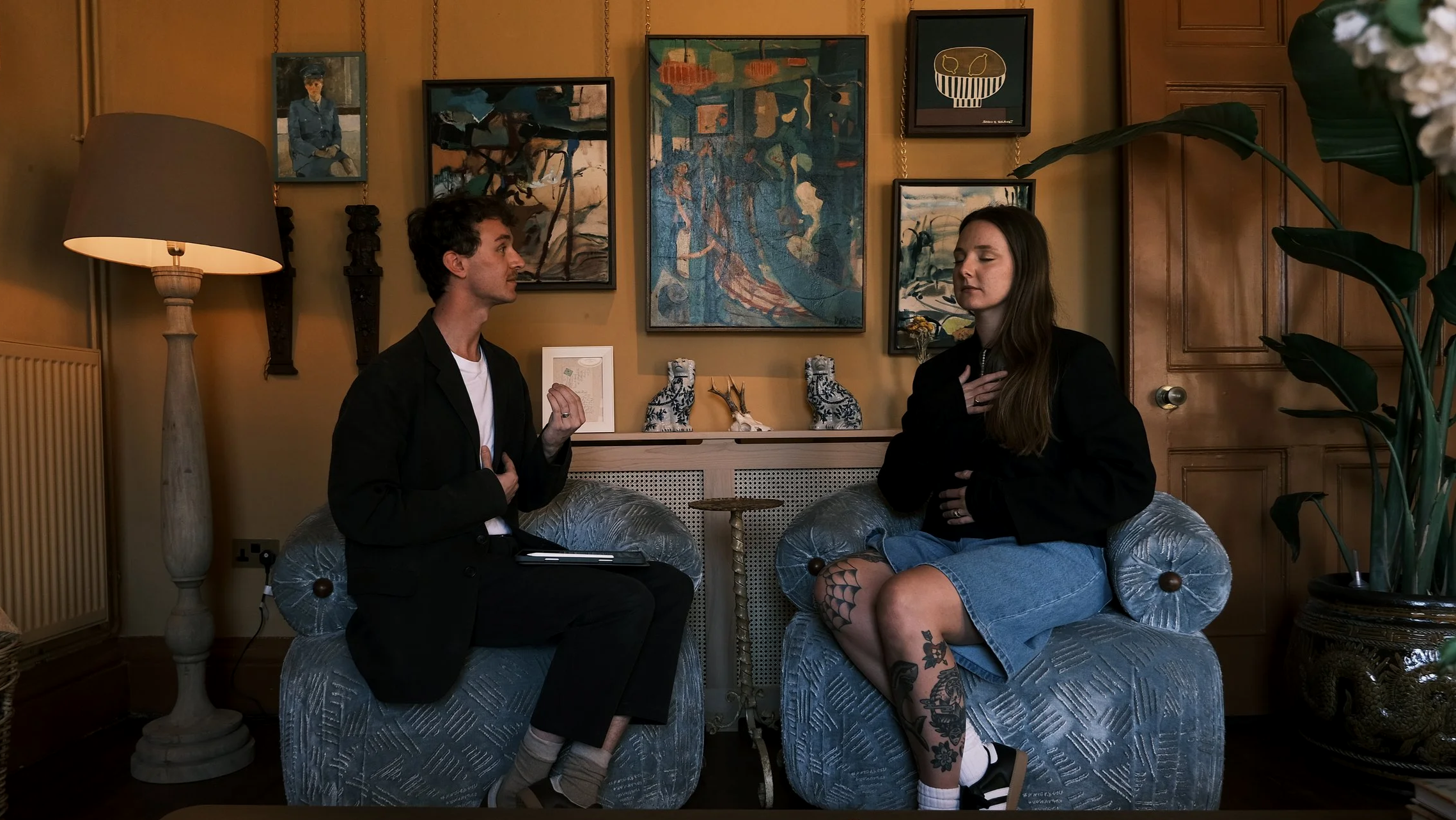
Most people spend a lot of money and a lot of years in rooms being encouraged to feel their feelings. Nobody ever just shows them how they work.
That’s what I do.
Your next chapter,
told by others